How to Bet on Fed Rate Cuts (2026 Guide)
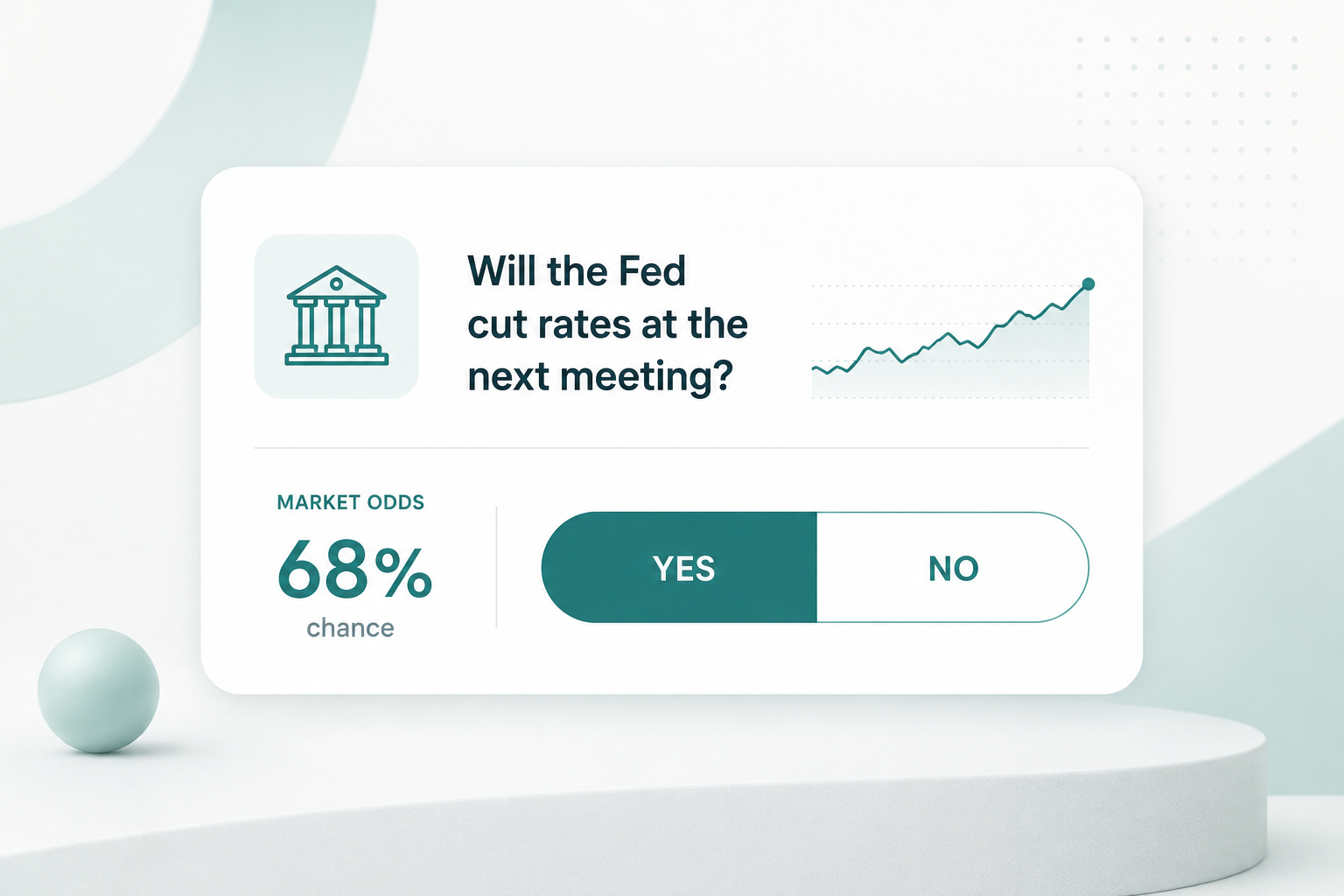
If you have a view on what the Federal Reserve will do next, you no longer have to express it through complicated options strategies or rate-sensitive ETFs. Prediction markets now let you directly bet on whether the Fed will cut rates -- at a specific meeting, by a specific amount, or a specific number of times in the year. This guide on how to bet on Fed rate cuts covers Polymarket and Kalshi, how the contracts resolve, what fees you will pay, and how to read the implied probability before you place a single dollar.
This is not financial advice. It is a practical walkthrough for anyone who already has a macro view and wants to understand the mechanics of acting on it through prediction markets.
What Are Fed Rate Cut Prediction Markets?
A Fed rate cut prediction market is a binary contract that asks a yes-or-no question about monetary policy -- "Will the Fed cut rates at the June meeting?" or "Will there be at least two Fed cuts in 2026?" Traders buy Yes shares or No shares at a price between $0.01 and $0.99. When the FOMC meeting concludes and the outcome is known, the winning side pays out exactly $1.00 per share. Every loser pays $0.00.
The elegance of this structure is that the price is the probability. A Yes share trading at $0.65 means the crowd currently prices a 65% chance the Fed cuts. If you think the true odds are higher -- say 80% -- you have positive expected value buying at 65 cents. If you think the market is overpricing a cut and the true odds are closer to 40%, you buy No at $0.35.
This is the same information the CME FedWatch tool shows from the futures market, made accessible in a simple buy-or-sell interface. Prediction markets track CME-derived probabilities closely, but they sometimes diverge after fast-moving news, creating brief trading opportunities. We publish the live market-implied probability on the MacroOdds Fed rate cut page so you can see where the market stands before you open a position.
Polymarket vs. Kalshi: Which Platform for Fed Rate Markets?
Two platforms dominate Fed rate prediction markets in 2026: Polymarket and Kalshi. They share the same basic contract structure but differ on regulation, geography, funding method, and fee design. Here is a direct comparison.
| Feature | Polymarket | Kalshi |
|---|---|---|
| Regulation | Unregulated globally; U.S. platform via QCX LLC in limited rollout | CFTC-regulated Designated Contract Market |
| U.S. Availability | Most states via QCX LLC; approximately 11 states restricted as of 2026 | Available in ~45 states; restricted in MD, MT, NJ, NV, OH |
| Funding Method | USDC stablecoin (Polygon network); no crypto on U.S. platform | ACH bank transfer, debit card, wire, crypto |
| Taker Fee (Economics) | 1.50% per taker trade | Up to ~1.75% (formula-based, lowest at extremes) |
| Maker Fee | Free on limit orders | Zero or rounded to $0.00 per contract at smaller sizes |
| Minimum Trade | ~$1 practical minimum | $0.01 per contract |
| Contract Resolution Source | FOMC official statements (federalreserve.gov) | FOMC official statements (federalreserve.gov) |
| Market Depth (Fed contracts) | Very high; some markets exceed $10M open interest | High; growing rapidly since CFTC regulatory win |
| Account KYC | Required for U.S. platform; varies globally | Required for all users |
Polymarket vs. Kalshi for Fed rate prediction markets, June 2026. Check each platform for current state eligibility.
Our read: Kalshi is the simpler on-ramp for U.S. residents. No crypto wallet needed, ACH from your bank account, and CFTC oversight means the legal picture is unambiguous in the states where it operates. Polymarket has deeper liquidity on individual contracts and a richer catalog of global macro events, which matters if you want to cross-trade Fed rate expectations against oil prices or Treasury yields. Serious macro traders often maintain accounts on both.
How Fed Rate Contracts Actually Resolve
Both platforms resolve Fed rate contracts using the official FOMC statement published on federalreserve.gov at 2:00 PM ET on the final day of each scheduled meeting. The resolution logic is straightforward.
For a binary "will the Fed cut?" market: Yes resolves to $1.00 if the FOMC lowers the target range for the federal funds rate. No resolves to $1.00 if the FOMC holds or raises. Emergency intermeeting cuts -- which are rare but do happen -- count exactly like scheduled-meeting cuts on Polymarket's annual contracts.
For "how many cuts this year?" markets: Polymarket and Kalshi both run multiple-outcome markets with separate contracts for 0 cuts, 1 cut, 2 cuts, 3 cuts, and 4+ cuts. Only one contract pays out at $1.00; all others go to zero. Each 25-basis-point reduction counts as one cut. A 50-basis-point cut in a single meeting counts as two cuts on Polymarket and as one "large cut" on separate Kalshi contracts. Read the specific market rules before trading these.
For specific-meeting rate-level markets: Kalshi lists "Fed funds rate after the June 2026 meeting?" contracts with multiple outcome buckets (4.00-4.25%, 4.25-4.50%, etc.). These resolve to the upper bound of the new target range as stated in the FOMC announcement. They are the most surgical expression of a rate view but require understanding where the current rate already sits before you trade.
How Implied Probability Maps to Price and Payout
This is the core math and it is simpler than it looks. Every contract is structured so that winning shares pay exactly $1.00 and losing shares pay $0.00. The price you pay is your cost basis and directly equals the crowd-implied probability. Understanding this table is the single most important thing you can do before learning how to trade Fed rate cuts.
| Yes Price | Implied Probability of Cut | Gross Payout if Yes Wins | Gross Return on Yes | No Price | Gross Return on No |
|---|---|---|---|---|---|
| $0.20 | 20% | $1.00 | +400% | $0.80 | +25% |
| $0.35 | 35% | $1.00 | +186% | $0.65 | +54% |
| $0.50 | 50% | $1.00 | +100% | $0.50 | +100% |
| $0.65 | 65% | $1.00 | +54% | $0.35 | +186% |
| $0.80 | 80% | $1.00 | +25% | $0.20 | +400% |
| $0.95 | 95% | $1.00 | +5% | $0.05 | +1,900% |
Price-to-probability mapping for binary Fed rate contracts. Returns are gross before platform fees.
The key insight from that table: the No side is not the "safe" side just because a cut is unlikely. A No share at $0.80 (meaning 80% probability of cut) only returns 25% if you are right. You need to be highly confident the market is wrong to make that trade worthwhile. The asymmetric return structure naturally attracts traders toward mid-probability markets where conviction gaps between your view and the crowd are most exploitable.
Step-by-Step: How to Trade Fed Rate Cuts on Kalshi or Polymarket
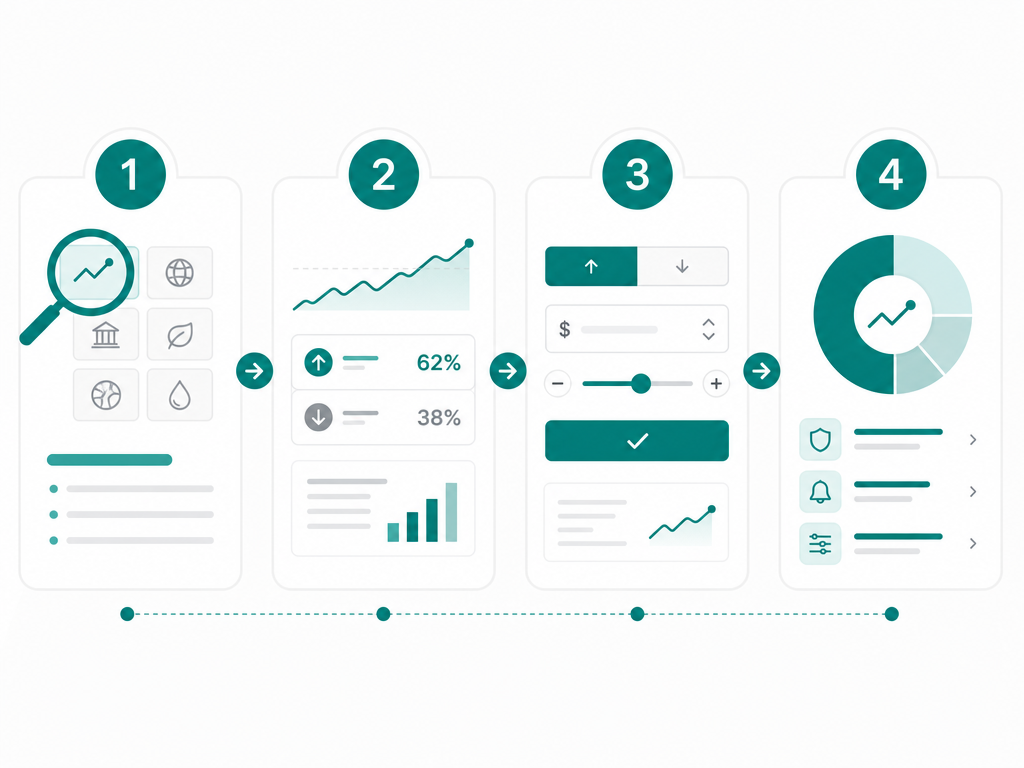
Here is the full workflow from account creation to a live position on a Fed rate market. We use Kalshi as the primary example because it is the most accessible path for U.S. residents, but the logic applies identically to Polymarket.
- Create and verify your account. Both Kalshi and Polymarket require identity verification (KYC) for U.S. users. On Kalshi, go to kalshi.com, register with your email, and upload a government-issued ID. Approval is typically instant. Verify your state eligibility first -- Kalshi currently restricts users in MD, MT, NJ, NV, and OH. Polymarket's U.S. platform has its own restricted state list.
- Fund your account. On Kalshi, connect a bank account and initiate an ACH deposit. There is no deposit minimum and no fee from Kalshi's side; funds are typically available within one business day. Debit card funding works instantly but carries a 2% processing fee. On Polymarket's global platform, you need USDC on the Polygon network. The cheapest path is buying USDC on Coinbase and withdrawing to Polygon, which avoids high Ethereum mainnet gas fees.
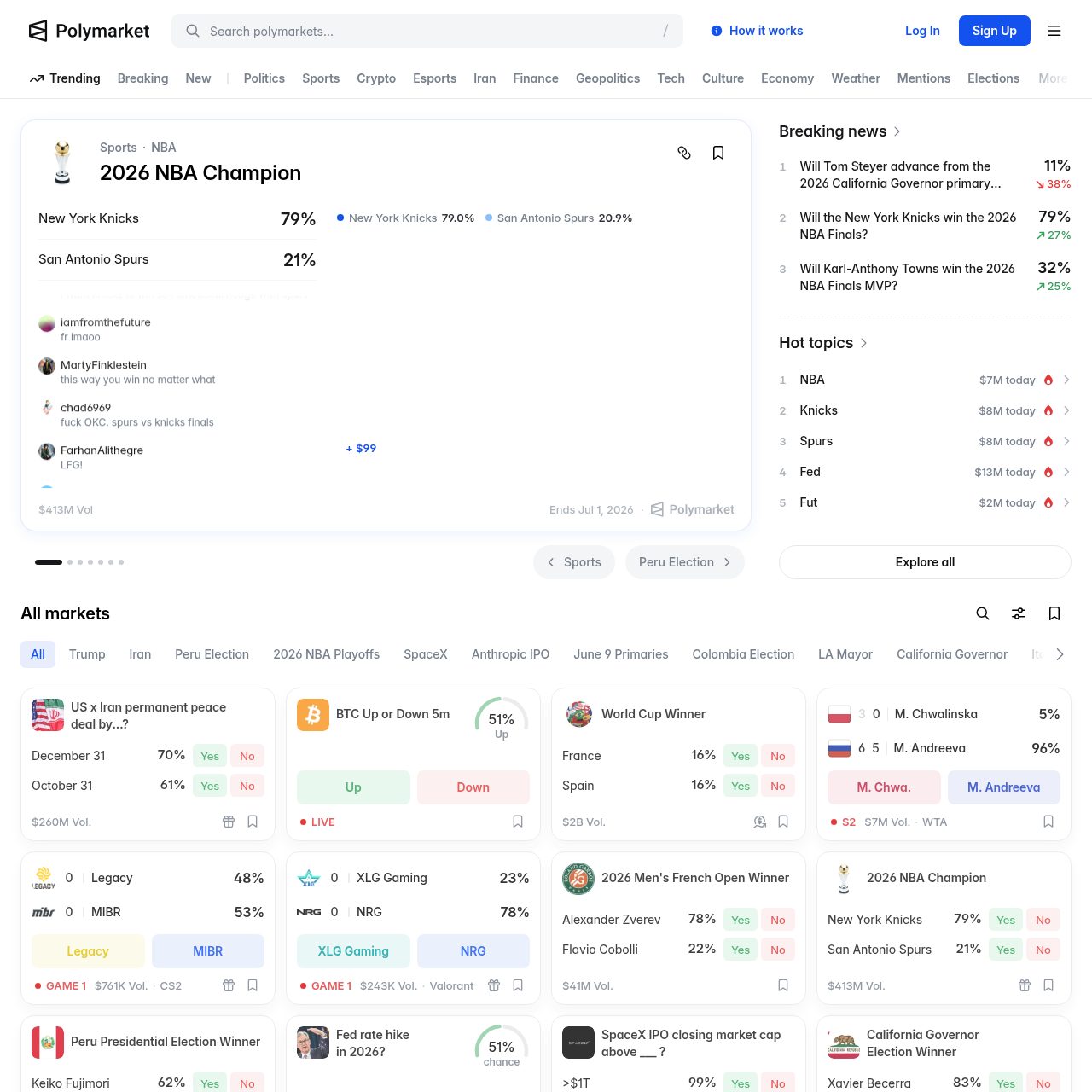
- Find the right Fed market. On Kalshi, navigate to the Economics or Fed category and look for markets labeled "Fed decision in [month]?" for a single-meeting bet, "Number of rate cuts in 2026?" for an annual view, or "Fed funds rate after [meeting]?" for a rate-level contract. On Polymarket, search "Fed" or browse polymarket.com/economy/fed-rates. Check the live MacroOdds Fed rate page first to know the current implied probability.
- Read the contract rules before you trade. Click into the market and read the full resolution criteria. Check: what counts as a cut, what is the resolution source, and what happens if a meeting is postponed. This takes two minutes and prevents surprises at resolution time.
- Decide on direction and sizing. If you believe the market is underpricing a cut, buy Yes. If you think a cut is overpriced, buy No. Start small -- there is no edge in sizing up before you understand how contracts move around data releases. A sensible first trade is 50-200 contracts ($25-$100 at a 50-cent price).
- Place a limit order to minimize fees. Both platforms charge lower fees on maker (limit) orders versus taker (market) orders. On Kalshi, set a limit order a penny or two inside the best ask rather than hitting the market. On Polymarket, limit orders are free while market orders incur the 1.50% taker fee. The discipline of limit-order trading also forces you to think about your actual entry price.
- Monitor and manage the position. Key data releases that move Fed rate markets include: CPI (mid-month), Core PCE (end of month), Non-Farm Payrolls (first Friday), and FOMC minutes and Fed Chair speeches. If your thesis plays out and the odds shift materially in your favor, you can sell for a realized gain well before the FOMC meeting.
- Understand the resolution timeline. After the FOMC meeting, the official statement is released at 2:00 PM ET. Both platforms resolve the relevant contracts within hours. Winning shares are credited to your account balance; losing shares go to zero. Withdrawal back to your bank account (Kalshi ACH) or crypto wallet (Polymarket) is available immediately after resolution.
Reading the Market Like a Macro Trader
Placing a trade is the easy part. The hard part is knowing when the market is wrong. The Fed rate market is priced by some of the sharpest capital in the world, including hedge funds, prop desks, and systematic macro traders who read every CPI component and every Fed speaker transcript. Having a view that differs from the market is table stakes; having a *correct* view is what earns the return.
Here is how to find edges in this market. First, watch the data that actually moves the Fed. CPI and Core PCE are the inflation numbers the Fed watches. Non-Farm Payrolls and the unemployment rate are the labor numbers. Any of these prints can shift the next-meeting cut probability by 10-20 percentage points in a single morning. If you form a view on an upcoming data release before it is fully priced in, you can position ahead of the catalyst.
Second, listen to what the Fed is actually saying. FOMC members communicate constantly through speeches, interviews, and the FOMC minutes. When Chair Powell uses language like "further progress on inflation" or "the labor market is no longer overheated," those are policy signals. The market prices them immediately, but interpretation varies. If you read the Fed communication differently from the consensus, that disagreement is the source of your potential edge.
Third, use the MacroOdds Fed page as your baseline. We aggregate live Polymarket and Kalshi Fed rate cut odds alongside CME-derived probability so you can see whether prediction markets are leading or lagging the futures market. A divergence between the two is often a short-lived arbitrage or a signal that one market is reacting faster to breaking news. The broader economic context -- including recession odds and inflation trends -- feeds directly into the Fed's decision calculus and should shape your overall thesis.
Fees and the Real Cost of Trading Fed Rate Markets
Fees are small enough that they rarely determine whether a trade is worth making, but they matter enough to understand before you start. The platforms have deliberately different fee structures.
Polymarket charges 1.50% on economics market taker orders. If you buy 100 Yes shares at $0.60 each (a $60 position), the fee is $0.90. Limit orders (maker orders) are free, which means if you are patient and let the market come to your price, you pay nothing. Most active traders on Polymarket use limit orders almost exclusively for this reason.
**Kalshi uses a fee formula: fee = round(multiplier * price * (1 - price), 2).** The multiplier for most markets is 0.07. For a contract priced at $0.50 (maximum uncertainty), the fee per contract is round(0.07 * 0.50 * 0.50, 2) = $0.02 per contract; on a 100-contract trade that is $2.00. For a contract priced at $0.90, the fee drops to round(0.07 * 0.90 * 0.10, 2) = $0.01. Near-certainty contracts are nearly free to trade. Maker fees are typically zero or rounded down at smaller sizes. Wire withdrawals carry a flat $25 fee; ACH withdrawals are free.
The practical conclusion: use limit orders on both platforms whenever you can wait even a few minutes for a fill. The fee difference between a patient limit order and an impatient market order can easily exceed 1% on mid-priced contracts, which is significant on a binary trade where your gross return might only be 30-50%.
Strategies for Different Macro Views
Your strategy depends on what macro thesis you are trying to express. Here are the most common views and how they translate into specific contract choices.
View: "The Fed will cut at the next meeting but the market is underpricing it." This calls for buying Yes on the single-meeting contract for that specific meeting. This is a short-duration trade that resolves cleanly in days or weeks. Your downside is capped at your stake; your upside depends on how far below 50 cents the market is currently sitting. Check when will the Fed cut rates for context on where consensus currently stands.
View: "There will be more cuts this year than the market expects." Buy Yes on the "3 or more cuts in 2026" contract or the "4 or more cuts in 2026" contract depending on your conviction. These are longer-duration trades that remain open through December and are highly sensitive to each data release along the way. They are the highest-variance, highest-potential-return expression of a dovish macro view.
View: "Inflation will stay sticky and the Fed will not cut at all." Buy No on the single-meeting contracts and Yes on the "0 rate cuts in 2026" contract on Kalshi. This is a contrarian position if the market is pricing multiple cuts, meaning the No shares will be cheap and the payout will be large if you are right. Correlate this view with the recession odds market -- a no-cut scenario and elevated recession probability can coexist but represent different transmission mechanisms for the economy.
View: "I want to scalp data releases without holding overnight." Buy Yes (or No) an hour before a CPI release if you have strong conviction on the print direction, and sell within minutes of the data landing if your thesis is confirmed. The risk is that the move is already priced in or that the market reacts in an unexpected direction. This approach requires familiarity with how rate markets have historically reacted to each data type.
Risks and What Can Go Wrong
Prediction market positions have a hard floor at zero, which makes them structurally less risky than leveraged futures. But several specific risks deserve attention when trading Fed rate markets.
Liquidity risk between meetings. The spread between Yes and No can widen significantly on low-activity days between data releases. If you need to exit a position in a thin market, you may not get a fair price. The best liquidity is in the days surrounding major data releases and in the final week before the FOMC meeting.
Resolution ambiguity on unusual Fed actions. A 50-basis-point cut, an intermeeting emergency cut, or a surprise hike can create resolution questions on markets that were not written to anticipate those scenarios. Both platforms publish detailed resolution criteria, but novel situations occasionally require operator judgment. Read the fine print on the specific contract you are trading, not just the headline question.
Platform risk. Both Polymarket and Kalshi hold user funds. Kalshi's CFTC-regulated status means it is subject to capital requirements and regulatory oversight that provide a meaningful layer of protection. Polymarket's global platform is less regulated. Position sizes should be proportionate to your comfort with platform risk, not just your conviction on the underlying macro view.
The market is often more right than you are. The single biggest risk in prediction market trading is overconfidence in your own macro view. The Fed rate market is priced by institutional capital with direct access to the same data you are reading. Before you bet that the market is dramatically wrong, ask yourself what information you have that the consensus does not.
Where to Track Live Fed Rate Odds Before You Trade
Before placing any position, you want to know the current market-implied probability, how it has moved over the past days and weeks, and how the prediction market price compares to the CME FedWatch implied probability. We built the MacroOdds Fed rate cut probability page to give you exactly that in one place.
That page pulls live Polymarket and Kalshi contract prices, plots them against the CME-derived probability, and shows the 30-day trend alongside the macro data releases that moved the odds. It is the fastest way to check whether your thesis is already fully priced before you risk capital.
If you want broader context on the macro environment -- including recession odds, the yield curve, and inflation trends that feed directly into the Fed's decision calculus -- those pages are linked throughout this guide and updated automatically on MacroOdds.
Frequently asked questions
Can I bet on Fed rate cuts?
Yes. Prediction markets including Polymarket and Kalshi list binary contracts that pay out $1.00 per share if the Federal Reserve cuts rates at a specific meeting or within a calendar year. You buy Yes shares if you think a cut will happen, or No shares if you think rates will hold or rise. The share price directly reflects the market-implied probability of the outcome.
Is it legal to bet on interest rates in the U.S.?
Kalshi is CFTC-regulated and legal for residents of most U.S. states, currently restricted only in MD, MT, NJ, NV, and OH. Polymarket operates a separate U.S.-facing platform via QCX LLC that launched in late 2025 and is available in most states, with approximately 11 states currently restricted. Always verify your state eligibility directly on each platform, as the legal landscape continues to evolve.
How do Fed rate markets resolve on Polymarket and Kalshi?
Both platforms resolve Fed rate contracts using the official FOMC statement published at federalreserve.gov at 2:00 PM ET on the last day of each scheduled meeting. Yes shares pay $1.00 if the announced target range reflects a cut; No shares pay $1.00 if the rate holds or rises. Emergency intermeeting cuts count toward annual totals on Polymarket's year-long contracts.
How does implied probability work on a prediction market?
The price of a Yes share equals the crowd-implied probability that the outcome occurs. A Yes share at $0.60 means the market collectively prices a 60% chance of a Fed cut. If the cut happens, you receive $1.00 per share; if it does not, you receive $0.00. You can compare this number directly to CME FedWatch futures-derived probabilities, and divergences often represent short-term trading opportunities.
What is the minimum amount I need to start trading?
On Kalshi, contracts are priced between $0.01 and $0.99, so a single-contract trade costs as little as a few cents. In practice, most traders work in lots of 50-200 contracts. On Polymarket's global platform, the practical minimum for a useful position is around $1-5 in USDC. Kalshi has a $1 technical deposit minimum; Polymarket has no formal deposit floor.
What fees do Polymarket and Kalshi charge on Fed rate markets?
Polymarket charges a 1.50% taker fee on economics market trades; limit orders (maker orders) are free. Kalshi uses a formula-based fee that peaks near 1.75% for mid-priced (around 50-cent) contracts and approaches zero for near-certain contracts. Both platforms charge no fee for ACH deposits; Kalshi charges $25 for wire withdrawals and a 2% processing fee for debit card funding.
Do I have to hold my position until the FOMC meeting?
No. You can sell your shares at any time before resolution. If you buy Yes shares at $0.35 and the odds move to $0.65 after a soft CPI print, you can sell and realize a gain without waiting for the FOMC meeting. Both Polymarket and Kalshi have active secondary markets for open contracts, and most Fed rate markets maintain tradeable liquidity throughout the contract's life.
What happens if the Fed does an emergency rate cut between meetings?
Emergency intermeeting cuts are rare but do happen -- the last major example was March 2020. On Polymarket's annual "how many cuts" contracts, emergency cuts count toward the total exactly like scheduled-meeting cuts. On Kalshi's per-meeting contracts, an emergency cut outside the scheduled meeting window may fall outside the scope of that specific contract. Always check the resolution rules for the exact contract you are trading before you assume an emergency move benefits your position.