What Are Prediction Markets? Polymarket & Kalshi Explained
What are prediction markets? They are financial exchanges where traders buy and sell contracts tied to real-world outcomes. The price of a contract at any given moment is a direct, financially incentivized estimate of the probability that the outcome will occur. If a contract trading at 34 cents asks "Will the Fed cut rates in September?", the crowd is saying there is a 34% chance the answer is yes. That single number, updated in real time by thousands of traders with real money on the line, often contains more signal than a month-old analyst note.
This is not a new concept. Historical records trace prediction markets back to 16th-century Italy, where contracts were written on papal succession. U.S. presidential election markets operated in the 19th century and produced reliable forecasts long before modern polling existed. What is new is scale: by April 2026, combined monthly trading volume on Polymarket and Kalshi alone had surpassed $24 billion. These are no longer niche curiosities. They are liquid, data-dense instruments that serious investors are paying attention to.
For macro investors, prediction markets are particularly compelling. Fed rate decisions, recession odds, unemployment thresholds, inflation surprises -- all of these now have active markets pricing outcomes in real time. At MacroOdds, we pull those live probabilities and pair them with official economic data so you can see what the crowd believes before the next FOMC statement drops.
How Do Prediction Markets Work?
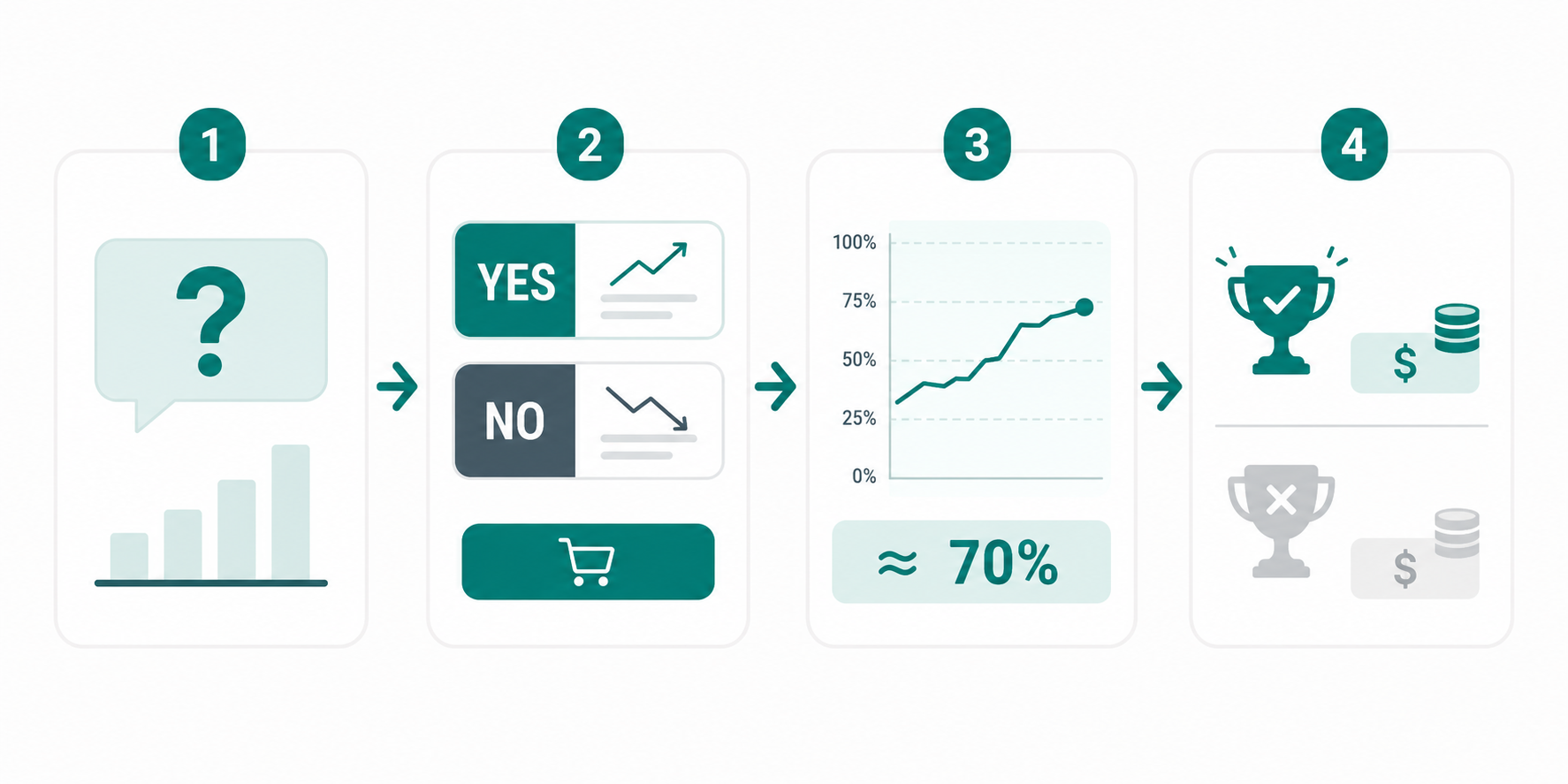
The mechanics are simpler than they look. Every market starts with a binary question: Will X happen by date Y? Traders can buy the "Yes" side or the "No" side. Each contract is worth $1.00 at resolution. If you buy the Yes contract for 34 cents and the event occurs, you collect $1.00 -- a profit of 66 cents. If the event does not occur, your contract settles at zero and you lose the 34 cents you paid. The No contract works identically in reverse: if you buy No for 66 cents and the event fails to occur, you collect $1.00.
Prices move constantly based on supply and demand. When new information enters the market -- a hotter-than-expected CPI print, a Fed chair speech, an unexpected jobs number -- traders reprice their positions. The resulting contract price is the market's aggregate, real-money estimate of probability. Because traders lose actual capital when they are wrong, they have a strong incentive to incorporate information accurately rather than to posture.
Most platforms support three market types beyond the basic binary: multiple-selection markets (which of several outcomes will occur, like "Which party wins the House?"), continuous markets (how high or low will a numerical outcome be), and conditional markets (if X occurs, will Y follow?). For macro watchers, continuous and conditional markets are especially powerful -- they let you trade on the magnitude of a rate cut or the sequencing of policy decisions.
Polymarket: The World's Largest Prediction Market
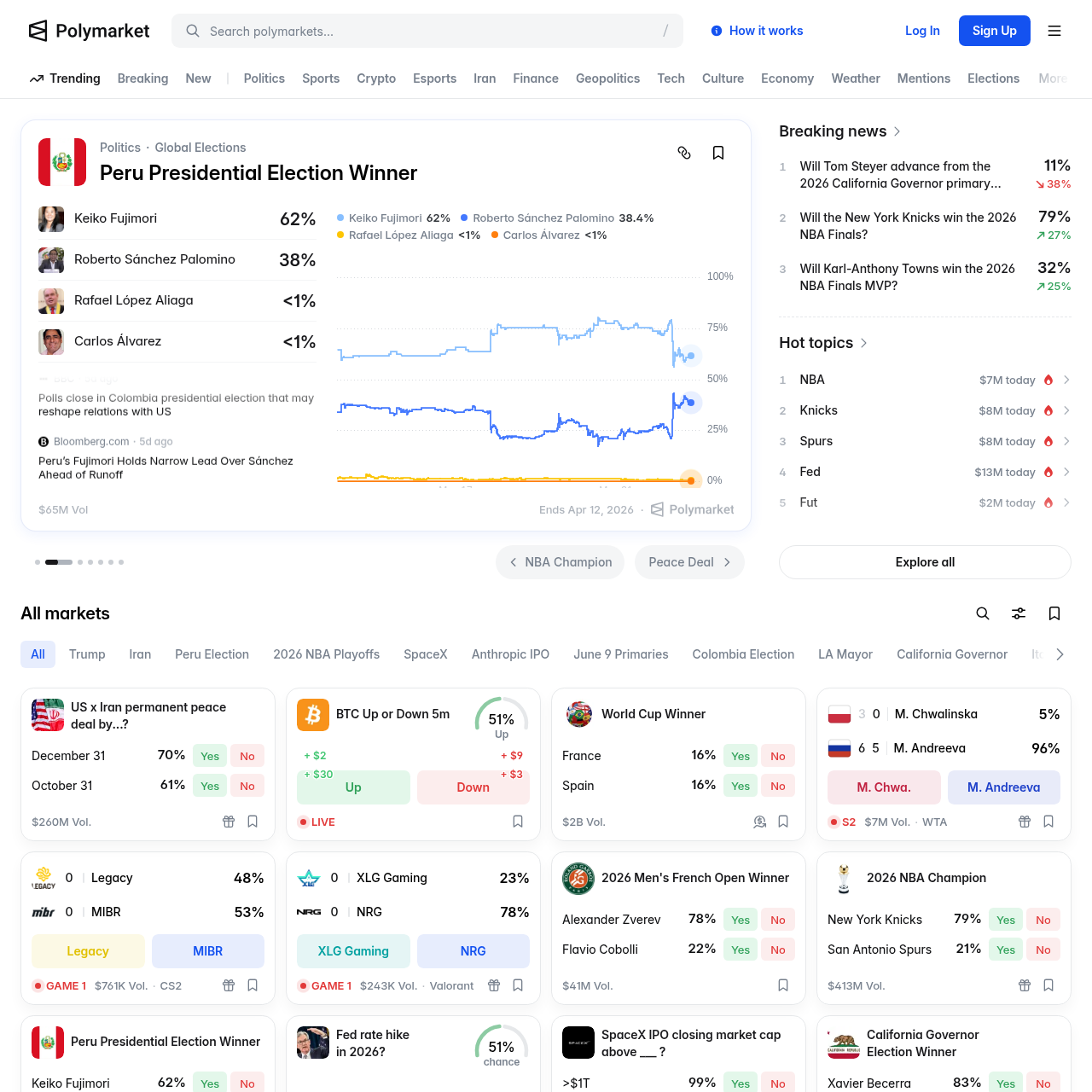
Polymarket launched in 2020 and has grown into the dominant global prediction market by volume. The platform recorded $10.57 billion in trading volume in March 2026 alone -- the first month it crossed the $10 billion threshold -- representing a 33% increase from February. Total 2025 trading volume reached $21.5 billion. Those are not fantasy numbers; they represent real capital being deployed on real outcomes by over 600,000 monthly active users.
Polymarket runs on the Polygon blockchain and denominates all trades in USDC, a dollar-pegged stablecoin regulated under U.S. federal law. Every trade, settlement, and resolution happens via smart contracts on-chain, giving the platform a trustless, transparent ledger that anyone can verify. Winning contracts automatically settle to $1.00; losing contracts go to zero. There is no house to beat, no spread manipulation -- just a limit-order book matching buyers and sellers.
Because Polymarket uses blockchain infrastructure, it currently restricts direct access for U.S.-based retail users, though that is evolving: the company has announced plans for a separate CFTC-regulated U.S. platform. Meanwhile, it is accessible in more than 180 countries, and institutional participants have no shortage of ways to interact with its price feeds. The platform's AI-powered Polysights tool and on-chain order-book data have also attracted a growing cohort of quant-oriented traders who treat Polymarket as a real-time sentiment signal.
Kalshi: The First CFTC-Regulated U.S. Exchange
If Polymarket is the offshore powerhouse, Kalshi is the regulated frontier. Founded in 2018 by two MIT graduates and headquartered in New York, Kalshi became the first Designated Contract Market (DCM) in U.S. history dedicated exclusively to event contracts when the CFTC approved it in November 2020. That puts Kalshi in the same regulatory category as the Chicago Mercantile Exchange and the Intercontinental Exchange.
The mechanics on Kalshi mirror the binary structure described above. Each contract has a face value of $1.00, priced in cents from 1 to 99 to reflect implied probability. Deposits and withdrawals work through standard banking channels -- ACH, debit card, or crypto -- with no blockchain wallet required. For U.S. investors who want the prediction-market signal without the crypto infrastructure, Kalshi is the cleanest on-ramp available.
Growth has been steep. Total event-contract volume on Kalshi reached $52 billion as of March 2026, and the platform now sees more than $2 billion in weekly trading volume. About 40% of that volume comes from institutional participants -- a meaningful signal that hedge funds and professional macro traders are treating these markets as legitimate inputs, not toys. Kalshi's October 2024 court victory over the CFTC, which definitively legalized election trading in the United States, removed the last major legal cloud over the platform.
Prediction Market vs. Sports Betting: They Are Not the Same
The comparison to sports betting gets made constantly, and it misses the point. At a sportsbook, you bet against the house. The house sets the line, builds in a margin (the "vig"), and actively limits or bans winning bettors. There is a structural conflict of interest: the sportsbook profits when you lose, so it has every reason to skew lines and manage exposure against you.
Prediction markets have no house. Kalshi and Polymarket are intermediaries -- they collect a small transaction fee on each trade, but they have no stake in the outcome. Prices are set entirely by the order book, not by a linemaker with an agenda. A sharp trader who is consistently right will never get limited or banned on Kalshi. That is a fundamental structural difference, and it is why institutional capital has moved into prediction markets while staying away from sportsbooks.
The other distinction is the information environment. Sports bets are grounded in game-specific factors most investors do not follow closely. Prediction markets cover the full range of real-world events -- including macro-economic outcomes that directly affect portfolios. Trading a "Will the Fed cut rates by 25 basis points in November?" contract is more closely related to fixed-income strategy than to a parlay on the NFC Championship game.
| Feature | Prediction Markets | Sportsbooks |
|---|---|---|
| Counterparty | Other traders (peer-to-peer) | The house |
| Price-setting | Open order book | Linemaker (with built-in edge) |
| Winning account risk | None | Limits and bans common |
| Revenue model | Transaction fee on both sides | Vig built into odds |
| Event types | Politics, macro, science, sports, more | Primarily sports |
| Regulation (U.S.) | CFTC (Kalshi); crypto-based (Polymarket) | State gaming commissions |
| Withdrawal method | Bank / ACH / crypto / debit | Bank / debit |
Prediction markets vs. sportsbooks: the structural differences that matter to investors.
Polymarket vs. Kalshi: Which One Should You Follow?
Both platforms price the same types of events, but they serve different users and carry different tradeoffs. The right answer for most investors is: follow both. Price discrepancies between the two platforms on the same market are themselves signals. When Polymarket shows 58% and Kalshi shows 52% on the same Fed question, there is something worth investigating in that gap -- and arbitrage-hungry traders will quickly narrow it if the difference persists.
| Polymarket | Kalshi | |
|---|---|---|
| Founded | 2020 | 2018 (launched 2021) |
| Regulation | Crypto-based; CFTC U.S. platform announced | CFTC Designated Contract Market |
| Currency | USDC (Polygon blockchain) | USD (standard banking) |
| 2025 trading volume | $21.5 billion | $17.1 billion |
| Monthly volume peak (2026) | $10.57B (March 2026) | $2B+ weekly |
| Institutional share | Growing; direct API access | ~40% of volume |
| U.S. retail access | Currently restricted for direct trading | Full access |
| Settlement | Smart contract, on-chain | Exchange clearing |
| Best for | Global liquidity, crypto-native traders | U.S. investors, regulated access |
Polymarket vs. Kalshi: a side-by-side comparison for investors.
Are Prediction Markets Accurate? What the Research Shows
The short answer is: yes, better than most alternatives -- but with important caveats. Researchers use Brier scores to measure forecast accuracy (lower is better, 0 is perfect). Polymarket's average Brier score across major political events has been measured at 0.15 to 0.18. Traditional polls typically score in the 0.22 to 0.25 range for the same events. Polymarket correctly called outcomes in roughly 73% of 2024 and 2025 elections ahead of final polling averages.
The mechanism behind that accuracy advantage is not mysterious. When you respond to a poll, you bear no cost for being wrong or for answering what sounds socially acceptable. When you buy a contract on Kalshi, you lose real money if you are wrong. That financial discipline filters out noise and forces traders to actually process new information rather than anchor to prior beliefs. The crowd is not always right, but it is systematically incentivized to try to be.
That said, prediction markets are not oracles. They can be manipulated -- during the 2024 U.S. presidential election, large coordinated trades on Polymarket drew scrutiny and accusations of wash trading. They also underperform on unprecedented events with no historical analog, where there is simply no information for the market to efficiently price. And like any financial market, they can stay mispriced longer than a rational observer expects when liquidity is thin.
For macro investors, the relevant track record is on Fed and economic outcomes. These markets tend to be particularly well-calibrated because the underlying events are watched by thousands of professional participants who are simultaneously trading rates, bonds, and derivatives. The prediction market does not replace the Treasury market signal; it complements it, often moving faster when information is fresh and the bond market has yet to fully reprice.
Prediction Markets vs. Polls: Why Money Beats Opinion
Polls measure stated preferences or beliefs. Prediction markets measure revealed beliefs backed by financial stakes. The difference is significant. When a polling respondent says they think Candidate A will win, they risk nothing -- there is no downside to wishful thinking or social desirability bias. When a prediction market trader buys a contract on Candidate A at 65 cents, they are committing dollars to that view and they will be systematically penalized if they let bias override analysis.
This is also why prediction markets update faster. A new piece of information -- a surprise inflation print, a Fed governor speech, a leaked document -- can reprice a market within minutes as traders rush to exploit the mispricing. Polls, by contrast, take days or weeks to field and process. In a fast-moving macro environment, that lag matters enormously.
Research published in 2026 notes that prediction markets are best understood as a complement to polling rather than a complete replacement. For rare or unprecedented events, both tools have blind spots. The most sophisticated approach is to triangulate: look at what the market says, what recent polling shows, and what official data implies, then form a view from the intersection of all three.
Macro Prediction Markets: Where Fed Watchers Find the Real Signal
Not all prediction market categories are equally useful for portfolio decision-making. Sports, crypto prices, and celebrity gossip generate enormous volume but are irrelevant to most investors. The macro category is different. Both Kalshi and Polymarket host active markets on Federal Reserve rate decisions, recession probability, U.S. unemployment thresholds, CPI outcomes, and Treasury issuance questions. These markets attract exactly the kind of sophisticated, financially motivated traders who are likely to price information accurately.
Think about who is trading the "Will the Fed cut rates by 25bp in September?" contract on Kalshi. It is the same universe of participants who are also positioning in fed funds futures, SOFR swaps, and short-duration Treasuries. These traders have strong financial incentives to get Fed calls right in their main books, and their prediction market activity tends to reflect their actual institutional views rather than casual speculation.
MacroOdds is built specifically around this signal. We track live Fed rate cut probabilities from Polymarket and Kalshi, alongside CME FedWatch data. We monitor recession odds from active prediction markets and overlay them against GDP nowcasts and the yield curve. We track Fed chair odds when leadership uncertainty is elevated. The goal is to give investors a single dashboard where the crowd's real-money view on macro policy is always one click away. If you want to move beyond reading the signal and start trading it, our guide on how to bet on Fed rate cuts walks through the mechanics step by step.
Getting Started With Prediction Markets
If you are new to this space, the clearest path to participation depends on where you sit. U.S.-based investors who want a fully regulated on-ramp should start with Kalshi -- no crypto wallet required, works with standard bank accounts, and you are trading on a CFTC-overseen exchange with the same legal standing as a futures market. The interface is intuitive and the contract catalog covers the major macro categories that matter for portfolio management.
Crypto-native investors or those outside the U.S. should look at Polymarket. You will need a USDC balance and a Polygon-compatible wallet, but the depth of liquidity on major markets is unmatched. The on-chain nature means complete transparency -- every trade is publicly verifiable on the blockchain, and sophisticated users can query the order book directly via API or through tools like Polymarket Analytics and Polysights.
Whether you trade or just read the signal, both platforms have free, publicly accessible odds pages. MacroOdds surfaces the most relevant macro markets directly so you do not have to sift through sports and celebrity contracts to find the Fed data you actually care about.
- Kalshi (kalshi.com): CFTC-regulated, U.S. bank accounts accepted, ~40% institutional volume, best for domestic investors.
- Polymarket (polymarket.com): Largest global volume, blockchain-native, USDC-denominated, best for crypto users and international traders.
- MacroOdds (macroodds.com): Aggregates live Fed and macro odds from both platforms alongside official economic data -- no account required to read the signal.
Frequently asked questions
What are prediction markets in simple terms?
Prediction markets are exchanges where traders buy and sell contracts on whether specific events will happen. The price of each contract -- set by supply and demand among real-money traders -- represents the crowd's probability estimate for that outcome. A contract priced at 40 cents implies a 40% chance the event occurs. When the event resolves, winning contracts pay $1.00 and losing contracts pay zero.
Is Polymarket legal in the United States?
Polymarket currently restricts direct trading for U.S.-based retail users through its main platform, which is crypto-native and operates outside U.S. jurisdiction. The company has announced plans for a separate CFTC-regulated U.S. platform. U.S. investors can access Polymarket's publicly visible odds without an account and can trade on the regulated Kalshi exchange as a domestic alternative.
How is Kalshi regulated?
Kalshi is the first Designated Contract Market (DCM) in the United States focused exclusively on event contracts. It operates under CFTC oversight in the same regulatory framework that governs the Chicago Mercantile Exchange and Intercontinental Exchange. A landmark court victory in October 2024 definitively legalized election trading on the platform.
Are prediction markets more accurate than polls?
On average, yes. Research shows prediction markets like Polymarket produce Brier scores of 0.15 to 0.18 on major political events, compared to 0.22 to 0.25 for traditional polls. The accuracy advantage comes from financial incentives: traders lose real money for being wrong, which filters out wishful thinking and social desirability bias that often distort poll responses. Prediction markets are not infallible, but they are systematically incentivized to be well-calibrated.
What is the difference between Polymarket and Kalshi?
Polymarket is a crypto-native, globally accessible platform running on the Polygon blockchain with the largest trading volume of any prediction market -- $10.57 billion in March 2026 alone. Kalshi is a CFTC-regulated U.S. exchange that accepts standard bank deposits and has strong institutional participation at roughly 40% of volume. Both price binary event contracts, but they serve different user bases and regulatory environments.
Can prediction markets be manipulated?
Yes, though doing so is expensive and usually temporary. During the 2024 U.S. election, large coordinated trades on Polymarket attracted scrutiny for potential wash trading. Short-term manipulation is possible in thin markets, but in high-volume markets with thousands of participants, any artificial price distortion creates an arbitrage opportunity that other traders will rapidly close. Deep, liquid markets are significantly harder to sustain manipulation in.
What macro events can I trade on prediction markets?
The range is wide and growing. Both Polymarket and Kalshi offer active markets on Federal Reserve rate decisions, U.S. recession probability, CPI and PCE outcomes, unemployment rate thresholds, Treasury issuance decisions, and Fed chair appointments, among others. MacroOdds tracks the highest-signal macro markets so you can monitor the crowd's real-money view on policy without browsing through unrelated categories.
How do prediction markets make money if they have no stake in the outcome?
Prediction market platforms earn revenue from transaction fees charged on each trade, similar to a stock exchange. Neither Polymarket nor Kalshi profits from traders losing -- they make money on the volume of activity regardless of which side wins. This removes the conflict of interest present in traditional sportsbooks, where the house benefits directly from losing bettors and has incentive to skew pricing against customers.