Fed Rate Cut Odds 2027: 56% by Year End

Search fed rate cut odds 2027 and every page hands you a single meeting's number without telling you which meeting, or quotes a ladder midpoint off a book nobody has traded. That is an expensive way to be wrong: the Fed raised rates in September, held in October with two members dissenting for another increase, and the contract with the deepest book on either exchange now prices a December hike at 77%.
So the honest answer to "what are the odds of a Fed rate cut" starts with a date. Priced by horizon rather than by meeting, the market says roughly 1.5% for a cut in what is left of 2026, 37.5% by July 2027, and 56% by the end of 2027. Those three numbers come from one Kalshi ladder that, as far as I can find, no other page on this query quotes.
I pulled every open contract on both venues within the same minute, read the settlement rules, checked each book's bid, ask and lifetime volume before trusting any midpoint, and ran the exchanges' overlapping 2026 contracts against each other as a coherence test. Then I checked all of it against this morning's payrolls release and the Fed's own October statement.
The short version: the cut is real but it is late, the 2027 meeting-by-meeting prices are much thinner than they look, and the single most quotable number on this topic (Polymarket's 47% for April 2027) is a 50-point-wide spread with $156 behind it.
Where Fed Rate Cut Odds for 2027 Sit Right Now
Kalshi runs a series called Next Fed rate cut (KXFEDCUT) that asks a cumulative question: will the next change in the target range be a cut, announced before a given date. That framing is the one a reader actually wants, and it is the one missing from every competing page I checked. All quotes below were pulled within the same minute.
| Question | Venue | Bid / ask | Mid | Lifetime volume | Read |
|---|---|---|---|---|---|
| Cut before 2027 | Kalshi KXFEDCUT | 1c / 6c | 3.5% | 810 | Mid unreliable, see below |
| Any cut in 2026 | Kalshi KXRATECUT | 1.3c / 1.6c | 1.45% | 1,702,561 | Deep book, trust this one |
| Zero cuts in 2026 | Polymarket | 97.6c / 97.8c | 97.7% | $9,507,709 | Implies 2.3% on one or more |
| Cut before July 2027 | Kalshi KXFEDCUT | 35c / 40c | 37.5% | 904 | Thin, 5-point spread |
| Cut before 2028 | Kalshi KXFEDCUT | 53c / 59c | 56.0% | 1,633 | Thin, 6-point spread |
| Cut before July 2028 | Kalshi KXFEDCUT | 79c / 88c | 83.5% | 1,304 | Thin, 9-point spread |
Kalshi public markets API and Polymarket Gamma API, pulled 2026-11-06 16:12 UTC. Mid is the midpoint of the best bid and best ask. Volume is lifetime contracts for Kalshi and lifetime dollars for Polymarket.
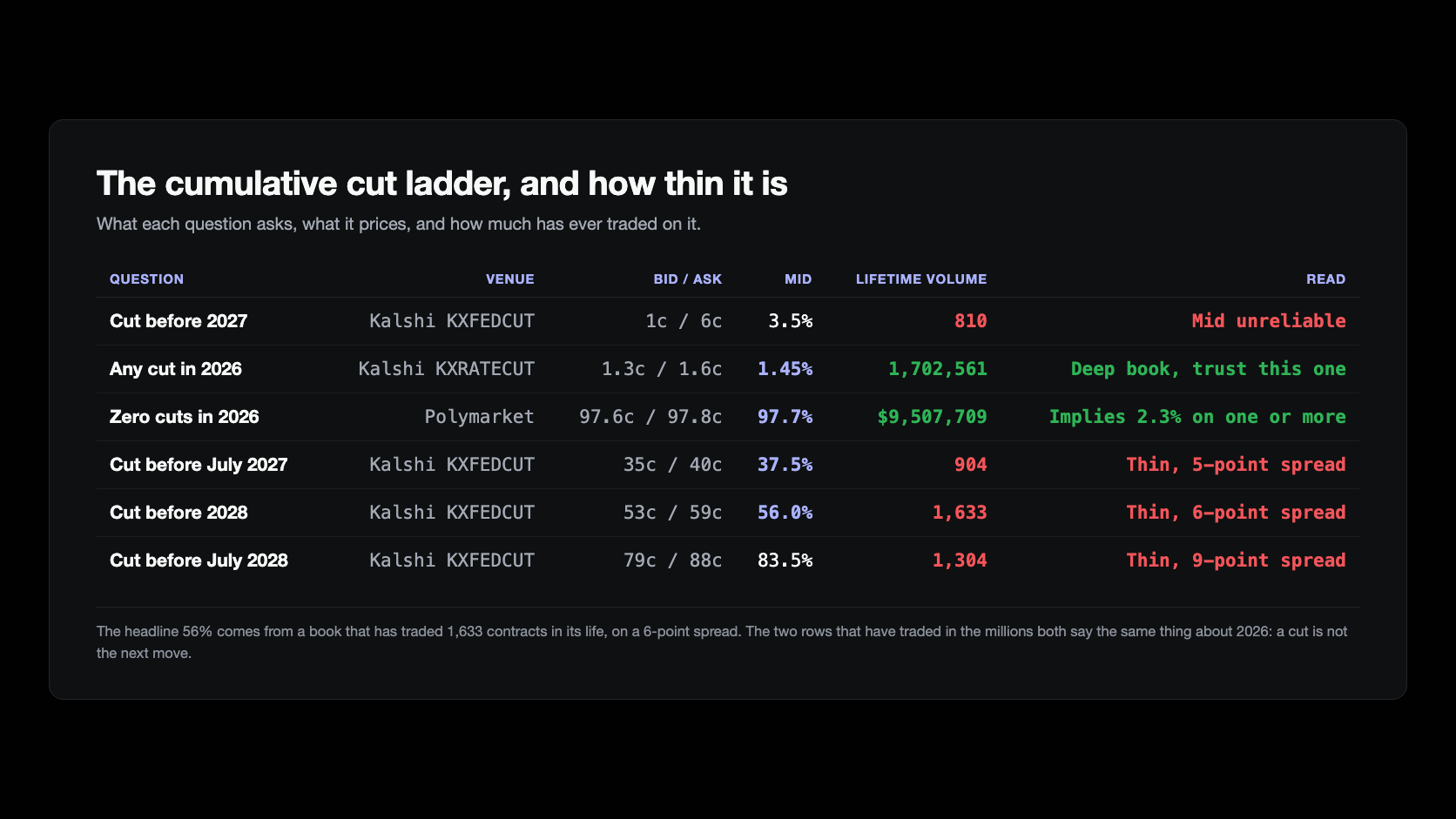
Two rows on that table ask the same question and disagree. Kalshi's own Cut before 2027 contract shows a 3.5% midpoint while its any cut in 2026 contract shows 1.45%, and the second one has traded 1.7 million contracts against the first one's 810. The 3.5% is not a signal. It is a 1c bid and a 6c ask with nothing in between, and the bid agrees with the liquid contract almost exactly.
Polymarket's whole-year book is the third read on the same window and lands in the same place: 97.7% on zero cuts in 2026, leaving 2.3% for one or more. The residual over Kalshi's 1.45% is the emergency-cut window, since Polymarket's contract stays open to December 31 while the meeting concludes on the 9th. Three independent books, one answer near 1.5%.
The Next Move Markets Price Is a Hike, Not a Cut
You cannot read a 2027 cut price without the December 2026 decision sitting next to it, because a hike in five weeks moves the whole ladder. The FOMC meets on December 8 and 9, and that meeting carries a Summary of Economic Projections, so the committee publishes a fresh dot plot the same afternoon.
| December 8-9 outcome | Kalshi bid / ask | Kalshi mid | Kalshi volume | Open interest |
|---|---|---|---|---|
| Hike 25bps | 76c / 78c | 77.0% | 1,194,740 | 695,519 |
| Fed maintains rate | 20c / 21c | 20.5% | 1,232,026 | 579,080 |
| Cut 25bps | 0c / 2c | 1.0% | 556,643 | 509,706 |
| Hike more than 25bps | 0c / 1c | 0.5% | 659,113 | 536,433 |
| Cut more than 25bps | 0c / 1c | 0.5% | 187,446 | 179,107 |
Kalshi KXFEDDECISION-26DEC, all five outcomes, pulled 2026-11-06 16:12 UTC. Volume and open interest in contracts. The five midpoints sum to 99.5%, which is as coherent as a one-cent tick allows.
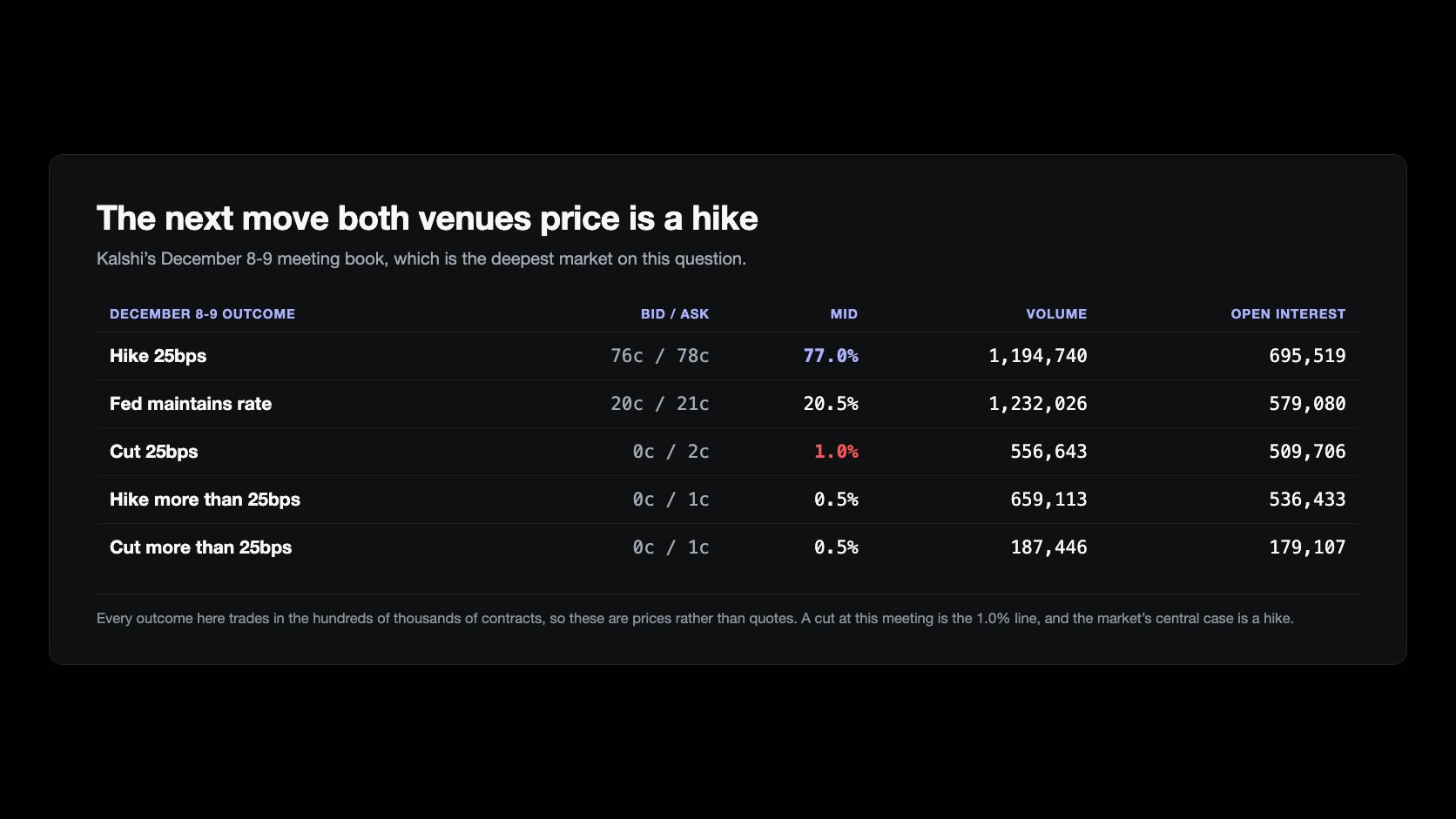
Polymarket agrees within a point. Its Another Fed rate hike in 2026? contract trades at 76% on a 75c/77c book with $1.57m of lifetime volume, and its separate end-of-2026 rate ladder puts 4.25% as the single most likely upper bound at 71.85% against 23.65% for an unchanged 4.00%. A 25bp hike from the current 3.75% to 4.00% range is exactly what gets you to a 4.25% upper bound, so three different Polymarket contracts and one Kalshi contract all describe the same December.
That matters for the cut question in a specific way. Every cut probability on this page is conditional on a tightening cycle that has not finished. The Fed raised the range by a quarter point to 3-3/4 to 4 percent on September 16 on a unanimous 12-0 vote, then held on October 28 by 10 votes to 2, with Governor Lisa Cook and Cleveland Fed President Beth Hammack both preferring an immediate increase. Dissents for tightening are the opposite of a committee preparing to cut.
A Cut Probability Means Nothing Without a Date
This is the distinction that makes most Fed-odds pages unusable, and it is worth two minutes. There are two different questions in circulation and they return wildly different numbers.
Kalshi's KXFEDCUT ladder is cumulative, so its numbers must rise as the date moves out, and they do: 1.45% in 2026, 37.5% by July 2027, 56% by January 2028, 83.5% by July 2028. That monotonic rise is a free sanity check, and it is why I trust this ladder's shape even where individual spreads are wide.
One row fails the check in a revealing way. Cut before July 2028 and cut before 2029 are quoted identically at 79c/88c. Logically the second must be at least the first, so equality is permitted, but identical nine-point spreads on both strikes is the signature of a single market maker quoting a ladder it has no particular view on. Treat the long end as a placeholder rather than a forecast.
Kalshi's 2027 Ladder, Cut Against Hike
Kalshi prices all eight 2027 FOMC meetings individually, which lets you put the cut and the hike for each date side by side. This is where the 56% cumulative figure comes from, and the shape is not what a normal easing cycle looks like.
| 2027 meeting | Cut 25bps | Cut bid / ask | Hike 25bps | Cut-side volume |
|---|---|---|---|---|
| January 26-27 | 2.5% | 2c / 3c | 19.5% | 40,344 |
| March 16-17 | 4.0% | 2c / 6c | 39.0% | 11,461 |
| April 27-28 | 10.5% | 10c / 11c | 11.5% | 8,736 |
| June 8-9 | 4.5% | 4c / 5c | 32.5% | 17,192 |
| July 27-28 | 3.5% | 2c / 5c | 3.5% | 22,676 |
| September 14-15 | 5.5% | 2c / 9c | 8.0% | 3,176 |
| October 26-27 | 4.5% | 3c / 6c | 3.0% | 82,105 |
| December 7-8 | 8.0% | 4c / 12c | 5.0% | 5,821 |
Kalshi KXFEDDECISION per-meeting contracts for 2027, pulled 2026-11-06 16:12 UTC. Meeting dates from the Federal Reserve's published FOMC calendar. March, June, September and December 2027 carry a Summary of Economic Projections.
Read the hike column first. It runs 19.5%, 39%, 11.5%, 32.5% and then collapses to single digits, so the market concentrates its remaining tightening risk in March and June 2027 and treats the second half of the year as settled. That is a coherent story: two more SEP meetings in which an inflation overshoot could force the committee's hand, after which the cycle is assumed done.
The cut column is the mirror image and it is much flatter, never clearing 10.5%. April 2027 is the first and only 2027 meeting where a cut outprices a hike, and it does so by a single point on a tight 10c/11c book with 8,736 contracts behind it. That is a real price, not an artifact, and it is the closest thing the market offers to a date for the first cut.
Note what the per-meeting numbers do not do: they do not add to 56%. Summing the cut column gives roughly 43%, which is not a meaningful quantity, because these are overlapping events on separate books. The cumulative ladder exists so you do not have to attempt that arithmetic.
Polymarket's 2027 Ladder Is Barely Traded
Polymarket runs the same per-meeting question under Fed rate cut by...?, and this is where a reader gets hurt. The event has $3.87m of lifetime volume, which looks authoritative, but almost all of it sits in meetings that have already resolved. The open 2027 contracts are close to empty.
| Polymarket contract | Displayed Yes | Best bid / ask | Spread | Lifetime volume | Kalshi's traded price |
|---|---|---|---|---|---|
| December 2026 meeting | 1.45% | 1.1c / 1.8c | 0.7pp | $458,570 | 1.0% |
| January 2027 meeting | 8.75% | 5.2c / 12.3c | 7.1pp | $8,929 | 2.5% |
| March 2027 meeting | 12.00% | 11.0c / 13.0c | 2.0pp | $6,198 | 4.0% |
| April 2027 meeting | 47.00% | 22c / 72c | 50.0pp | $156 | 10.5% |
| June 2027 meeting | 30.00% | 11c / 49c | 38.0pp | $27 | 4.5% |
| July 2027 meeting | 49.00% | 14c / 84c | 70.0pp | $162 | 3.5% |
Polymarket Gamma API event 106884 against the matching Kalshi KXFEDDECISION contracts, both pulled 2026-11-06 16:12 UTC. Displayed Yes is the price Polymarket's own interface shows. Spread in percentage points.
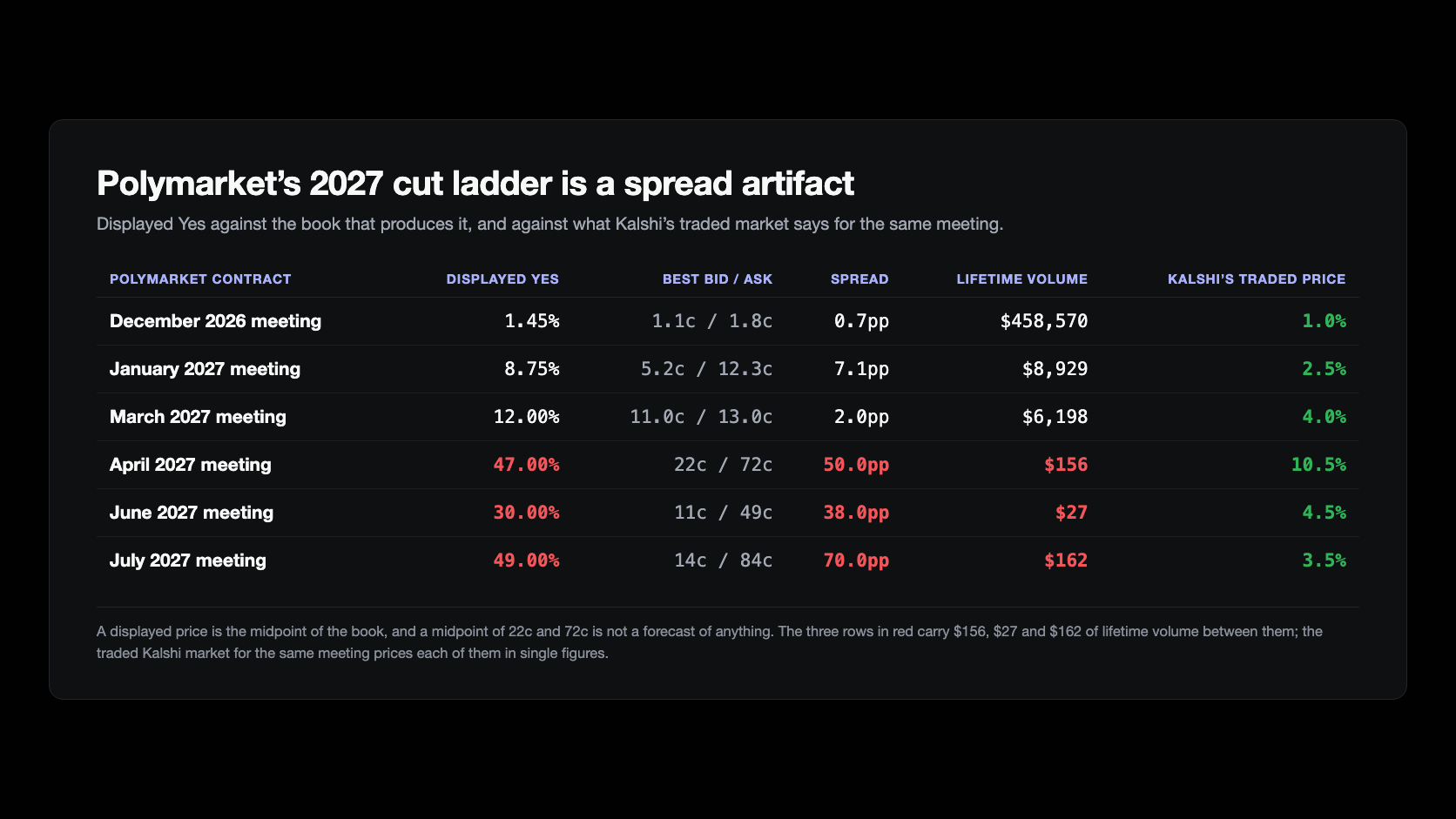
The bottom three rows are the whole problem. Polymarket displays 47% for an April 2027 cut on a book that is 22 bid at 72 offered with $156 of lifetime volume, and 49% for July 2027 on a 70-point spread with $162 behind it. A midpoint struck halfway between two quotes that nobody will trade against is not a probability, it is the average of two market makers' worst cases.
Kalshi's traded books for those same two meetings say 10.5% and 3.5%. I would take those, and not because Kalshi is the better venue in general. I would take them because 8,736 and 22,676 contracts have changed hands at those levels while $156 and $162 have changed hands at the other.
Where Polymarket's books are real the venues agree closely. The December 2026 contract is quoted 1.1c/1.8c on $458,570 and lands within half a point of Kalshi's 1.0%. The March 2027 contract holds a 2-point spread on $6,198 and sits 8 points above Kalshi, a genuine disagreement rather than an artifact. The test is never which venue, it is always whether the book trades.
What Today's Jobs Report Did to the Cut Case
The October employment report landed at 8:30 this morning and it ran hard against the cut. The BLS reported 165,000 nonfarm payrolls against a consensus near 59,000, and the unemployment rate fell to 4.1% from 4.2%.
The revisions matter more than the headline. August went from 133,000 to 186,000 and September from 29,000 to 60,000, a combined 84,000 higher than previously reported. That 29,000 September print was the number the market read as labour-market softness six weeks ago, and this site's October cut-odds piece was written against it. It has now more than doubled.
Average hourly earnings rose 0.4% on the month to $38.00 and 3.1% over the year. That is not a wage spiral, but it sits above the pace consistent with 2% inflation and removes the one argument a cut advocate had left.
A committee that already has two members dissenting for a hike does not cut into 165,000 payrolls and a falling unemployment rate. The December hike contract sat near 72% in the first days of November and prices 77% now, and this morning is the obvious reason.
Inflation Is the Reason the Cut Is Priced Out
Labour data sets the timing, but inflation is why a 2027 cut is a coin flip rather than a certainty. Every gauge the committee watches is above target, and the one it targets formally is moving the wrong way.
| Gauge | Latest reading | Period | Prior | Released |
|---|---|---|---|---|
| Core PCE (the Fed's target measure) | 3.1% y/y | September 2026 | 3.0% | October 29, 2026 |
| Headline PCE | 3.6% y/y | September 2026 | n/a | October 29, 2026 |
| Headline CPI | 3.7% y/y | September 2026 | 3.4% | October 14, 2026 |
| Core CPI | 2.6% y/y | September 2026 | 2.5% | October 14, 2026 |
| Average hourly earnings | 3.1% y/y | October 2026 | n/a | November 6, 2026 |
| FOMC target | 2.0% | longer run | unchanged | n/a |
Bureau of Economic Analysis Personal Income and Outlays for September 2026, Bureau of Labor Statistics CPI for September 2026 and Employment Situation for October 2026. Core PCE is the gauge the FOMC's 2% objective is defined against.
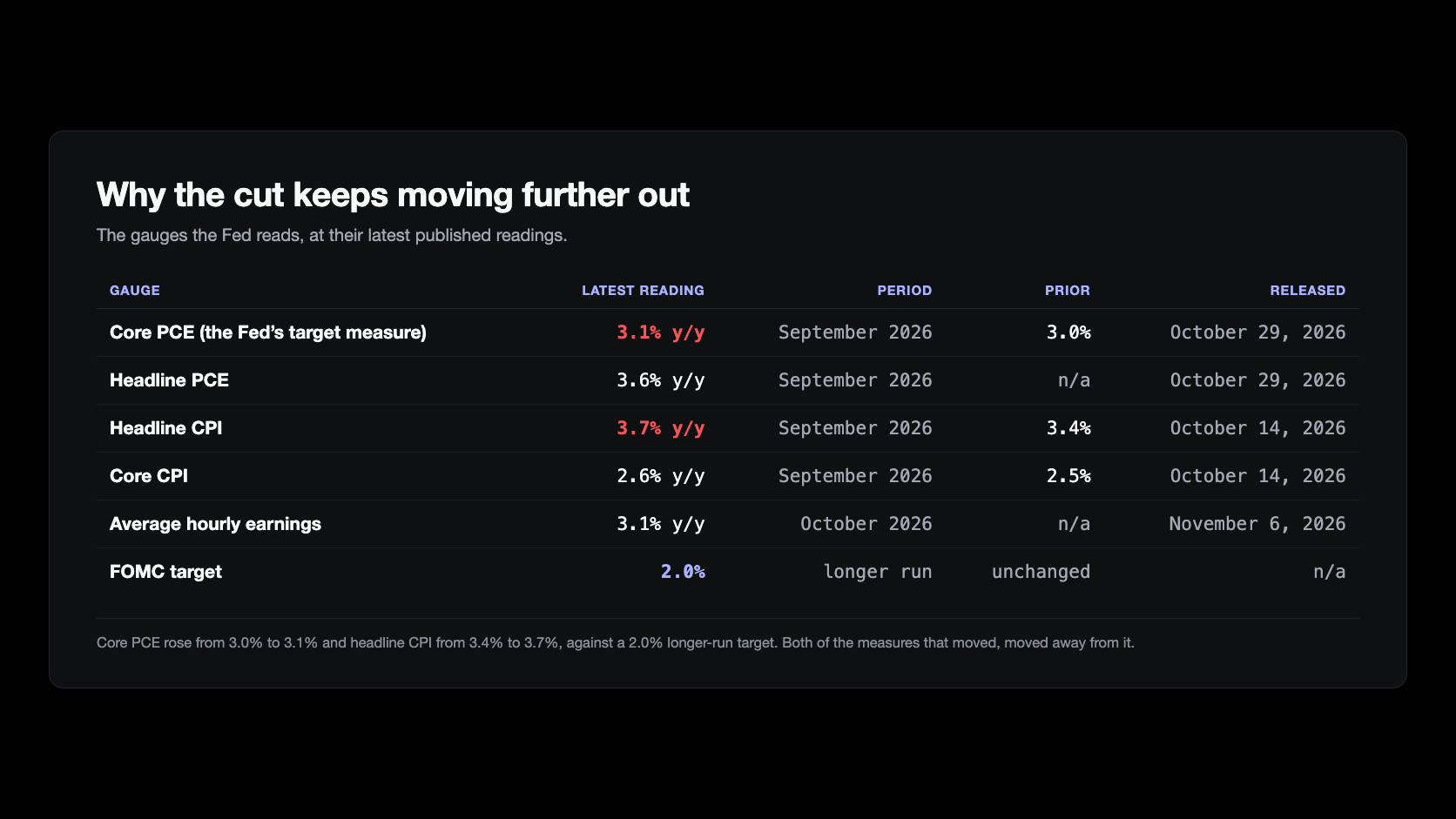
Core PCE at 3.1% is more than a full point above target and rose from 3.0% in August. The October 28 statement said flatly that "inflation remains elevated", which is the language a committee uses when it is not done.
The split between the two headline measures is the one place a cut argument survives. Headline CPI jumped to 3.7% from 3.4% on a 0.6% monthly print, and the move was overwhelmingly energy: gasoline rose 9.1% and accounted for roughly half the index increase. Core CPI, which strips that out, is at 2.6%. If the energy impulse fades, headline inflation falls without a single rate cut, and that is the scenario the 56% is partly pricing.
Two dates decide whether that holds. October CPI arrives on November 10 and September's personal income and outlays successor on November 25, both before the December 8 meeting begins. Our CPI and inflation odds page tracks the contracts on the first of those.
What Would Put a 2027 Cut Back on the Board
A 56% cumulative price is not a forecast of easing, it is a statement that the market is genuinely unsure. Here is what would move it, roughly in order of how much each would shift the ladder.
- Core PCE turning down for two consecutive months. One print is noise and the committee has said so repeatedly. Two consecutive declines toward 2.5% would do more than any other single development, because it attacks the only stated reason for staying tight.
- A December hold instead of the priced hike. The hold contract is at 20.5%. If it resolves, the whole 2027 ladder reprices upward for cuts immediately, because the cycle would be over a meeting earlier than assumed.
- Unemployment breaking above roughly 4.5%. Today's 4.1% is the wrong direction entirely. A labour market that cracks is the classic trigger, and it is the path that would take the 2027 cut price well above 56% fastest.
- The energy impulse reversing. Half of September's CPI increase was gasoline. A sustained fall in crude pulls headline inflation down mechanically and gives the committee cover it does not currently have.
- A shift in committee composition or leadership. Dissents are currently for tightening, not easing. The reverse pattern, or a change at the top, would reprice the back end of the ladder. Our Fed chair odds page tracks the contracts on that question.
What would not move it: another strong quarter of GDP, or an equity selloff. Neither is in the committee's reaction function at current inflation, and the 2027 ladder has shown no sensitivity to either over the period I have been tracking it.
For now the ladder says the same thing three different ways. The next move is a hike at 77%, a cut in 2026 is a 1.5% proposition, and a cut by the end of 2027 is close enough to even money that anyone quoting a single confident number for fed rate cut odds 2027 is quoting the midpoint of a book you should check first.
Frequently asked questions
What are the odds of a Fed rate cut in 2027?
Kalshi's cumulative Next Fed rate cut contract prices a cut announced before 2028 at 56%, on a 53c/59c book. The same ladder puts a cut before July 2027 at 37.5%. Per individual meeting the numbers are much smaller, peaking at 10.5% for April 2027, because a per-meeting contract and a by-this-date contract answer different questions.
Will the Fed cut rates in 2026?
Almost certainly not. Kalshi's any-cut-in-2026 contract trades at 1.3c bid and 1.6c ask, a 1.45% midpoint, on 1.7 million contracts of lifetime volume. Polymarket's whole-year book prices zero cuts in 2026 at 97.7%. A cut at the December 8-9 meeting itself is 1.0% on Kalshi and 1.45% on Polymarket.
Is the Fed going to hike instead of cut in December 2026?
That is what the deepest books on both venues price. Kalshi puts a 25bp hike at the December 8-9 meeting at 77% on 1.19 million contracts, and Polymarket's another-hike-in-2026 contract is at 76% on $1.57m. The Fed raised rates by a quarter point on September 16, 2026 and held on October 28 by 10 votes to 2, with both dissenters preferring an increase.
When is the first Fed rate cut priced?
April 27-28, 2027 is the first and only 2027 meeting where a cut outprices a hike on Kalshi, at 10.5% against 11.5%, and it trades on a tight 10c/11c book. That is the closest the market comes to naming a date, though at 10.5% it is a long way from a consensus call.
Why does Polymarket show 47% for an April 2027 rate cut?
Because that number is a midpoint of an untraded book, not a probability. The contract is quoted 22c bid against 72c offered, a 50-point spread, with $156 of lifetime volume. Kalshi's book for the same meeting has 8,736 contracts behind a 10c/11c quote. Check lifetime volume and spread width before using any ladder price.
Why do the per-meeting cut odds not add up to 56%?
Because they are overlapping events, not exclusive ones. The Fed cutting in March 2027 and cutting again in June 2027 can both happen, so summing the column is not a valid operation. Summing Kalshi's 2027 cut column gives about 43%, which is not a meaningful figure. Use the cumulative contract for a by-this-date answer.
What inflation reading would make a 2027 cut more likely?
Core PCE falling for two consecutive months toward 2.5% would matter most, because it is the gauge the FOMC's 2% objective is defined against and it currently sits at 3.1% for September 2026, up from 3.0% in August. Headline CPI at 3.7% is flattered by a 9.1% gasoline rise, so a reversal in energy prices would pull the headline down without any policy change.
Did the October 2026 jobs report change the cut odds?
It pushed them further out. Payrolls came in at 165,000 against a consensus near 59,000, unemployment fell to 4.1% from 4.2%, and August and September were revised up by a combined 84,000 on November 6, 2026. The December hike contract was near 72% in early November and prices 77% after the release.
Sources
- Federal Reserve, FOMC calendars and meeting dates for 2026 and 2027
- Federal Reserve, FOMC statement of October 28, 2026 (range held at 3-3/4 to 4 percent, 10-2 vote, Cook and Hammack dissenting for a hike)
- Federal Reserve, FOMC statement of September 16, 2026 (quarter-point increase to 3-3/4 to 4 percent, 12-0)
- Bureau of Labor Statistics, Employment Situation for October 2026, released November 6, 2026
- Bureau of Economic Analysis, Personal Income and Outlays, September 2026 (core PCE 3.1%)