Who Will Be the Next Fed Chair? 2026 Odds
The question "who will be the next Fed chair" dominated macro trading desks, prediction-market dashboards, and political-finance conversations for the better part of a year. Jerome Powell's term was expiring, Donald Trump had spent two-plus years telegraphing his desire for a rate-cutting replacement, and a dozen names were circulating in Beltway circles -- each carrying different implications for the yield curve, the dollar, and the path of monetary policy.
Now we have an answer. Kevin Warsh was sworn in as the 17th chair of the Federal Reserve on May 22, 2026. But the real story is not just who won -- it is how prediction markets like Polymarket and Kalshi processed the uncertainty in real time, surfacing signal weeks before official announcements. If you traded those markets or used them as a hedge against your macro book, you lived this race in a way cable news viewers simply did not.
In this piece we replay the entire nomination arc: the candidates who were seriously priced, the confirmation drama, what Warsh's appointment means for rate-cut probability, and where the next Fed-market-moving question lives now that this one has resolved.
Why Jerome Powell Was Always Going to Be Replaced
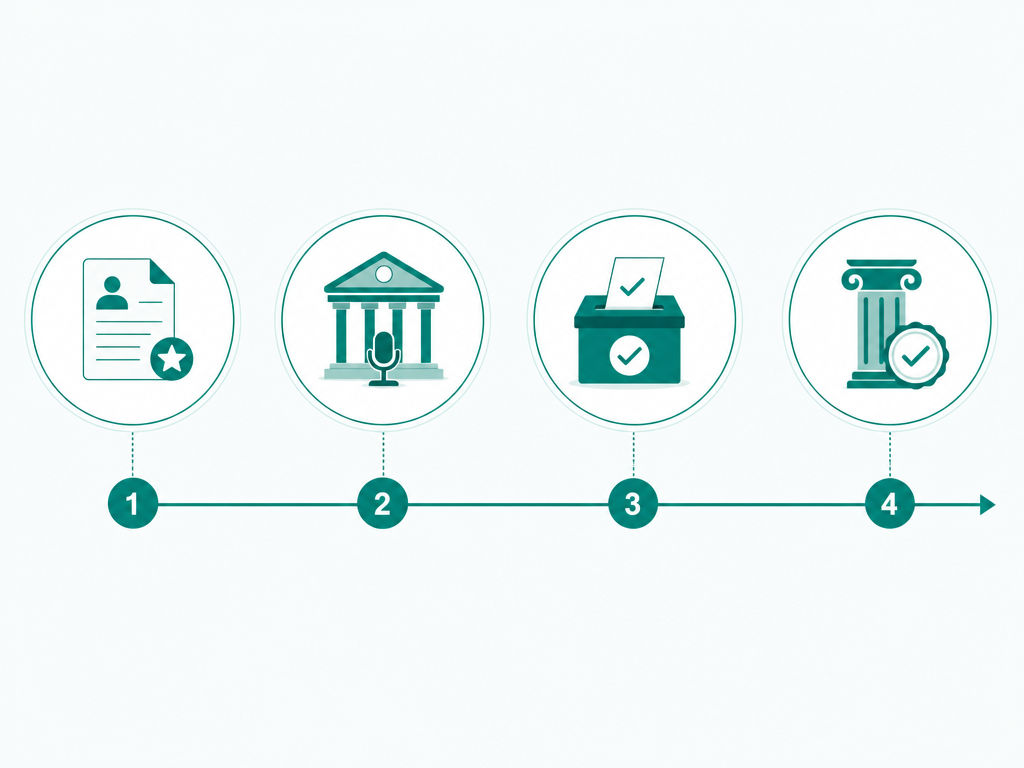
Under the Federal Reserve Act, the president nominates a Fed chair from the Board of Governors for a four-year term. The Senate Banking Committee vets the nominee, advances them with a committee vote, and the full Senate confirms. A chair can serve multiple terms if re-nominated, but Powell's relationship with the Trump White House made re-nomination a non-starter before the 2024 election was even called.
Powell's second four-year chair term ran from May 2022 to May 15, 2026. His governor seat -- a separate, 14-year appointment -- runs to 2028, which is why he announced he would stay on the board rather than resign outright. That decision, unusual in Fed history, kept him as a potential institutional counterweight even after handing the chair to Warsh.
From a prediction-market perspective, the relevant question opened almost immediately after the 2024 election: when would Trump announce his pick, and who would it be? Both Polymarket and Kalshi launched markets on the nomination months before any shortlist was officially confirmed.
| Step | What Happens | Who Acts | 2026 Actual Date |
|---|---|---|---|
| President announces nominee | White House signals intent via statement or social media | President Trump | January 30, 2026 |
| Senate Banking Committee hearing | Nominee testifies; senators question on policy and independence | Senate Banking Committee | April 2026 |
| Committee vote | Committee advances (or kills) nomination to full Senate | Committee members | Late April 2026 |
| Full Senate floor vote | Simple majority required; 51 votes (or 50 + VP) to confirm | Full Senate (100 members) | May 13, 2026 |
| Swearing-in | Nominee takes oath, officially becomes chair | Chief Justice or designee | May 22, 2026 |
The five-step process that put Kevin Warsh in the chair.
The Reported Contenders: Who the Market Was Pricing
Treasury Secretary Scott Bessent ran the vetting process. At its widest the field touched eleven names, spanning sitting Fed officials, outside economists, and Wall Street operators. By January 2026, four candidates remained in serious contention. We describe them as the market knew them -- by their perceived policy lean, not as certain picks.
| Candidate | Role at Time of Vetting | Policy Lean | Why Markets Watched Them |
|---|---|---|---|
| Kevin Warsh | Hoover Institution Fellow; former Fed Governor (2006-2011) | Hawkish / institutionally orthodox | Deep financial-crisis experience; called for "regime change" at the Fed but committed to independence |
| Christopher Waller | Sitting Federal Reserve Governor | Hawkish-to-neutral | Already inside the institution; strong macro-modeler credentials; could have confirmed without a second Senate vote |
| Rick Rieder | Chief Investment Officer, BlackRock Fixed Income | Market-friendly / pragmatic | Deep bond-market experience; thought to be the frontrunner as late as the Thursday before the announcement |
| Kevin Hassett | National Economic Council Director, White House | Growth-oriented / dovish on rates | Close Trump ally; Trump ultimately praised him too much to move him out of the NEC role |
The four finalists as reported before Trump's January 30, 2026 announcement. Policy leans are market characterizations, not official positions.
Warsh was a dark horse for much of late 2025, with Rieder commanding the highest probability on several platforms heading into the final weekend. That gap closed fast once reporting shifted. The Polymarket confirmation market -- "Who will be confirmed as Fed Chair?" -- had Warsh climbing from roughly 30 cents to near-certain within 48 hours of the announcement, illustrating exactly how prediction markets collapse uncertainty on new information.
Polymarket and Kalshi: What the Markets Actually Showed
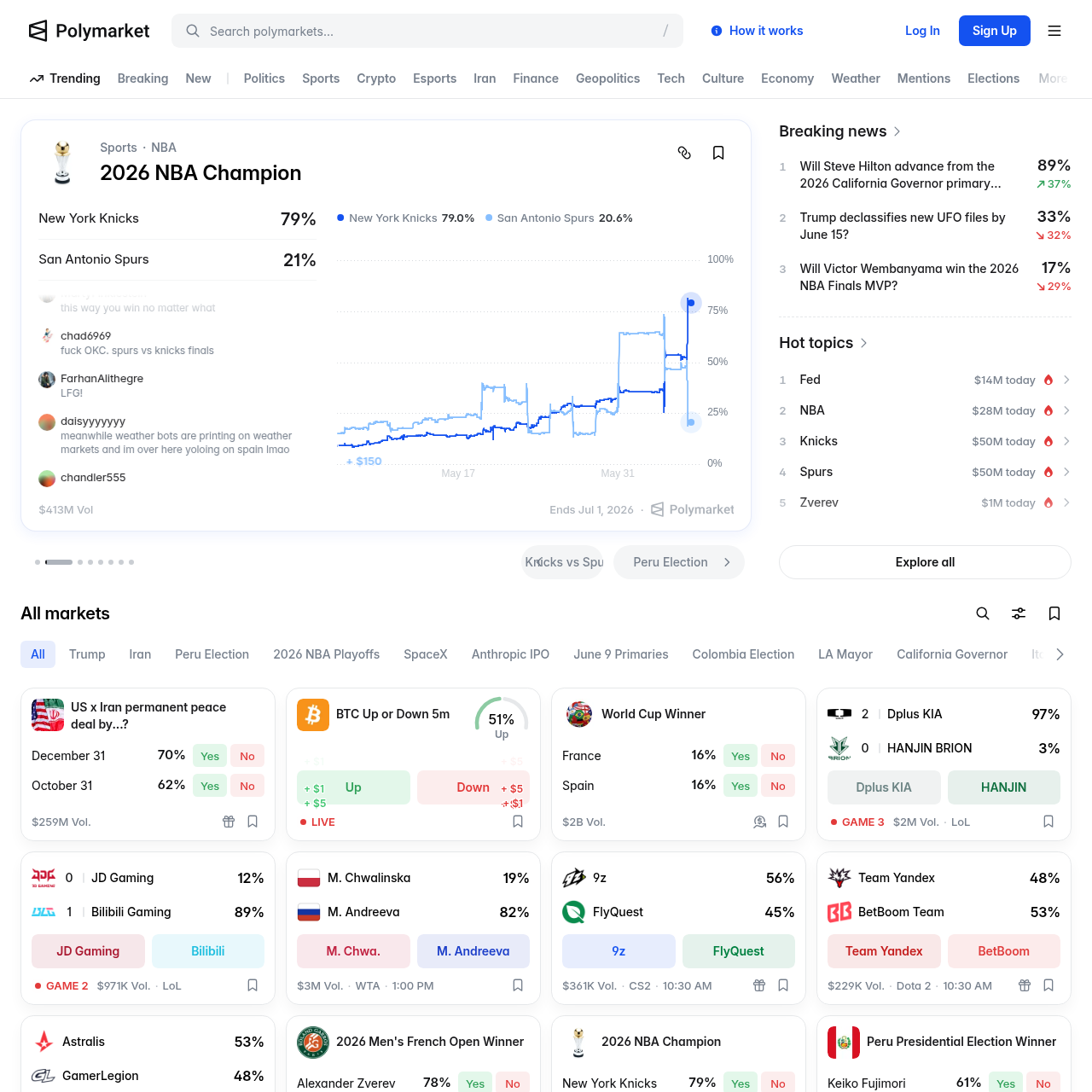
Polymarket ran several separate Fed chair markets: who Trump would announce as nominee, who Trump would nominate formally, and who the Senate would confirm. This layering mattered -- the nomination and the confirmation were two distinct risks, and the Tillis objection (more on that below) meant confirmation was not a formality even once the nomination was in.
The "Who will be confirmed as Fed Chair?" market on Polymarket alone generated $64.5 million in total trading volume after launching March 4, 2026. That volume reflects genuine economic stakes: bond desks, macro hedge funds, and individual traders all had real money reasons to express a view on who would control the most powerful monetary policy lever in the world.
Kalshi ran a parallel "Who will Trump nominate as Fed Chair?" contract that resolved in Warsh's favor as well. The two platforms operate differently -- Polymarket uses cryptocurrency settlement on a decentralized protocol, while Kalshi is a CFTC-regulated exchange settling in dollars -- but both produced broadly consistent probability paths throughout the race. When markets disagreed, the gap represented real uncertainty about nomination versus confirmation timing.
The MacroOdds fed-chair odds page aggregates these market signals alongside official Fed calendars, so you can see how the market is pricing the next leadership-driven rate decision in one place. Bookmark it -- the next meaningful repricing happens June 16-17, Warsh's first FOMC meeting as chair.
Kevin Warsh: The Chair Who Called for Regime Change
Warsh, 56, is not a central banker who appeared out of thin air. He served on the Board of Governors from February 2006 to March 2011 -- becoming the youngest Fed governor in history at 35 -- and was deeply involved in crisis response during 2008: the Bear Stearns sale, the Lehman collapse, and the AIG bailout. He watched the financial system fracture in real time and formed strong opinions about how the Fed communicates and acts.
After leaving the board in 2011 (he dissented on QE2 and resigned shortly after), Warsh spent the better part of 15 years at Stanford's Hoover Institution and as a partner at Duquesne Family Office. That outside-the-building perspective hardened into a pointed critique: in a summer 2025 CNBC interview, he called for "regime change" at the Fed, arguing that the institution's credibility deficit lay with its incumbents.
That framing made some market participants nervous -- would he simply do Trump's bidding on rates? His Senate testimony softened the picture considerably. Warsh pledged to use independent judgment on rate decisions and offered an unusually nuanced inflation framework, suggesting that AI-driven productivity gains and supply shocks deserve more granular treatment than the blunt 2% PCE target allows. Markets received this as hawkish-but-credible, not the political yes-man some had feared.
The Tillis Objection and the Narrowest Confirmation in Memory
Between nomination and confirmation stretched a political obstacle that prediction markets had to price: Senator Thom Tillis of North Carolina announced he would oppose any Fed nominee until the Justice Department's probe into Powell's building renovation was resolved. With Republicans holding 53 seats, losing even two members meant failure -- so Tillis's position was serious.
The market-implied probability of confirmation dropped noticeably after Tillis's statement. It recovered as the White House worked to resolve the DOJ inquiry and as Warsh's Senate Banking Committee hearing went smoothly. By late April 2026 the committee had advanced the nomination. The floor vote on May 13 ended 54-45, with Pennsylvania Democrat John Fetterman crossing the aisle as the sole Democratic vote.
That 54-45 margin was the narrowest confirmation for a Fed chair in the modern era. It reflects how politicized the Fed appointment process has become -- and it also means Warsh enters his term with the thinnest political mandate of any recent chair. That context matters for how he manages dissent inside the FOMC and how assertively he pushes back against White House pressure.
What Warsh Means for Rates and Why It Matters to Your Portfolio
The chair's most tangible market impact runs through the federal funds rate -- the overnight rate that anchors everything from mortgage rates to corporate bond yields. As of his swearing-in, traders were pricing very few cuts for the remainder of 2026, with the fed funds rate expected to land somewhere around 3% by year-end. Inflation is still running above the Fed's comfort zone, and the labor market, while cooler, has not cracked.
Warsh's hawkish inflation history suggests he will not rush to ease. His own language about price stability -- that it should be a state "no one talks about" -- implies he will want to see several months of benign CPI and PCE prints before moving. That is meaningful context for how to read CPI vs. PCE as competing gauges of where the Fed threshold sits.
At the same time, Warsh's "regime change" framing was partly structural: he wants to reform how the Fed communicates, review its framework for setting the neutral rate, and potentially revisit the 2020 average-inflation-targeting policy. Framework changes move long-end rates, sometimes dramatically, and that is the risk macro traders should watch over the next 12-18 months as Warsh settles in. The fed-rate-cut-probability page tracks real-time market pricing for each upcoming FOMC meeting.
How to Track Live Fed Chair and FOMC Odds Going Forward
The "next Fed chair" question is settled for now -- Warsh holds the seat until 2030. But the prediction-market landscape around the Fed is richer than a single appointment. Polymarket and Kalshi both run continuous markets on rate decisions at every FOMC meeting, and those markets price in new information (jobs reports, CPI prints, Fed speeches) faster than most institutional forecasts adjust.
Here is how to read those markets as a macro trader. Each contract is a binary: will the Fed cut, hold, or hike at the next meeting? The market price is the implied probability. A 25-cut contract at 0.30 means the crowd assigns 30% to a quarter-point cut. Watching these prices move in the hours after a Fed speech or economic release tells you how much the market is updating relative to consensus -- that delta is actionable information.
The 2024-2026 Fed chair race was a masterclass in how prediction markets handle leadership uncertainty: they aggregated dispersed information, priced confirmation risk separately from nomination risk, and resolved quickly when hard news arrived. The same infrastructure will process the next major Fed uncertainty event, whatever form it takes. When will the Fed cut rates? Our analysis of FOMC probabilities is updated after every data release.
Using Prediction Markets as a Macro Lens: What the Fed Chair Race Taught Us
Prediction markets are not magic. They aggregate the views of market participants willing to put capital behind their beliefs, which makes them valuable but not infallible. The Fed chair race showed both the strengths and limits. Polymarket had Rieder briefly as the highest-probability pick the day before Warsh's announcement -- which means the market was wrong until it was right. That is not a failure; that is information being efficiently repriced when new signals arrived.
For macro traders, the correct way to use these markets is as a probabilistic lens, not an oracle. A 70% Warsh probability meant: if you saw a path where Warsh was not picked, you had edge fading that probability. If you had no special information, the market price was probably your best estimate. This is exactly how sophisticated desks use prediction-market data alongside traditional macro research.
Both Polymarket and Kalshi have expanded their Fed-related market offerings significantly in 2025-2026: nomination markets, confirmation markets, rate-decision markets, and even markets on specific speech outcomes. The volume and depth have grown to the point where institutional desks are incorporating these prices into their risk models. That trend is likely to continue through Warsh's term -- and the next appointment cycle in 2030 will produce another high-stakes race worth following closely.
Frequently asked questions
Who will replace Jerome Powell as Fed chair?
Kevin Warsh replaced Jerome Powell as Federal Reserve chair. Warsh was nominated by President Trump on January 30, 2026, confirmed by the Senate 54-45 on May 13, 2026, and sworn in on May 22, 2026. His four-year term as chair runs until May 21, 2030. Powell remains on the Board of Governors until 2028.
When does the Fed chair term end?
The Fed chair serves a four-year term. Kevin Warsh's term as chair runs until May 21, 2030. Note that the chair term and the governor term are separate: a chair also holds a 14-year governor seat, which does not expire when the chair term ends. Jerome Powell, for example, stepped down as chair in May 2026 but remains a governor until January 2028.
How is the Fed chair chosen?
The Federal Reserve Act requires the president to nominate a Fed chair from the Board of Governors for a four-year term. The nomination is vetted by the Senate Banking Committee, which holds hearings and advances the nominee with a committee vote. The full Senate then votes to confirm by simple majority. A new governor seat may also require separate confirmation if the nominee is not already sitting on the board.
When will the next Fed chair be appointed after Warsh?
Kevin Warsh's current term runs until May 21, 2030. Assuming no early departure, the next nomination process would begin in late 2029 or early 2030, depending on the political calendar. The president in office at that time will nominate a replacement, subject to Senate confirmation.
Who were the other candidates considered for Fed chair in 2026?
The final four contenders reported by major outlets were Kevin Warsh (the eventual pick), Federal Reserve Governor Christopher Waller, BlackRock fixed income chief Rick Rieder, and National Economic Council Director Kevin Hassett. Treasury Secretary Scott Bessent led the vetting process across a broader field of roughly eleven names before narrowing to the finalists.
What are Kevin Warsh's views on interest rates and inflation?
Warsh has a historically hawkish record on inflation, dissenting against QE2 during his first stint at the Fed (2006-2011). He has pledged to exercise independent judgment and not take rate orders from the White House. His preferred definition of price stability -- prices that "no one is talking about" -- signals he will hold rates until inflation is clearly subdued. Markets are pricing few if any cuts through end of 2026 under his leadership.
How did Polymarket and Kalshi track the Fed chair race?
Both platforms ran multiple overlapping markets: who Trump would announce as nominee, who would receive the formal nomination, and who the Senate would confirm. The Polymarket confirmation market alone generated over $64 million in trading volume. Prices on each candidate moved in real time as reporting shifted -- Warsh's probability climbed from roughly 30% to near-certain within 48 hours of the announcement.
What does the Fed chair appointment mean for interest rates?
The chair leads the Federal Open Market Committee, which sets the federal funds rate. A hawkish chair (more concerned about inflation) tends to hold rates higher for longer; a dovish chair is more willing to cut to support growth. Warsh is generally viewed as hawkish, and markets are pricing a higher-for-longer rate environment through at least the end of 2026. His first FOMC meeting as chair is scheduled for June 16-17, 2026.