Will the Fed Cut Rates in December 2026? Just 0.4%

Search will the Fed cut rates in December and you get a tracker widget with no date on it, or a page still quoting a September snapshot where a cut was 7%. Neither tells you the thing that actually matters four weeks out: a December cut is priced at 0.35%, and the live disagreement among traders is whether the Fed raises by a quarter point or a half point on December 9.
That is a very different article from the one most of these pages are writing. If you came here hoping for cheaper mortgage quotes in January, the honest answer is that both exchanges put a cut of any size somewhere between 0.6% and 1.0%, and the October CPI print that landed this morning pushed it down rather than up.
So here is what I did instead of quoting a tracker. I pulled every open contract on the December meeting from Polymarket Gamma and the Kalshi public API inside the same minute, read both settlement rules so the numbers mean the same thing, measured today's repricing hour by hour from Polymarket's own CLOB price history, and checked all of it against the Bureau of Labor Statistics release and the Fed's September projections.
The short version: the cut is not a live outcome at this meeting, the hike is, and the interesting number on the board today is a 50bp tail that was half a percent at breakfast and is near 10% tonight.
Will the Fed Cut Rates in December 2026? The Direct Answer
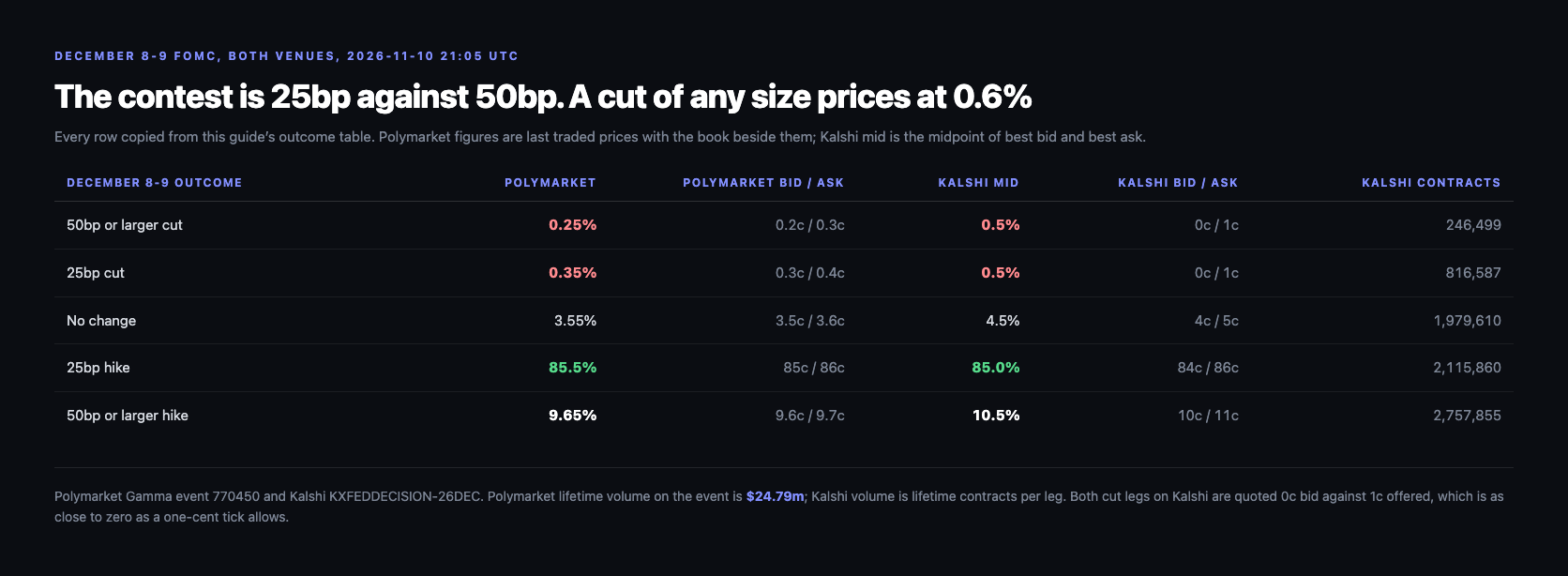
The FOMC meets on December 8 and 9, 2026, with the statement at 2:00 p.m. ET on the Wednesday. Both venues run a five-outcome ladder on that decision, and both ladders put the two cut legs at the bottom. Every quote below came out of the same minute.
| December 8-9 outcome | Polymarket | Polymarket bid / ask | Kalshi mid | Kalshi bid / ask | Kalshi contracts |
|---|---|---|---|---|---|
| 50bp or larger cut | 0.25% | 0.2c / 0.3c | 0.5% | 0c / 1c | 246,499 |
| 25bp cut | 0.35% | 0.3c / 0.4c | 0.5% | 0c / 1c | 816,587 |
| No change | 3.55% | 3.5c / 3.6c | 4.5% | 4c / 5c | 1,979,610 |
| 25bp hike | 85.5% | 85c / 86c | 85.0% | 84c / 86c | 2,115,860 |
| 50bp or larger hike | 9.65% | 9.6c / 9.7c | 10.5% | 10c / 11c | 2,757,855 |
Polymarket Gamma event 770450 and Kalshi KXFEDDECISION-26DEC, pulled 2026-11-10 at 21:05 UTC. Polymarket figures are last traded prices with the book shown beside them; Kalshi mid is the midpoint of best bid and best ask. Polymarket lifetime volume on the event is $24.79m; Kalshi volume is lifetime contracts per leg.
Two things are worth noticing before you read any single number off that table. First, these are not thin books. Polymarket has traded $24.8m across the event and holds $2.24m of resting liquidity, and every Kalshi leg has traded in the hundreds of thousands of contracts, with over a million of open interest on the three hike-or-hold legs. These are prices, not quotes.
Second, the two venues agree to within a point on every outcome, which is unusual and useful. The widest gap is 0.95 points on no change. When two exchanges with different settlement sources, different user bases and different currencies land this close, the number is doing real work rather than reflecting one venue's idiosyncrasy.
October's CPI Repriced the Size of the Hike, Not the Direction
The October Consumer Price Index landed at 8:30 a.m. ET this morning, 13:30 UTC, and it ran hot. The BLS reported that the all-items index rose 0.4% on the month after 0.6% in September, and that the index less food and energy rose 0.3%. Both were above consensus.
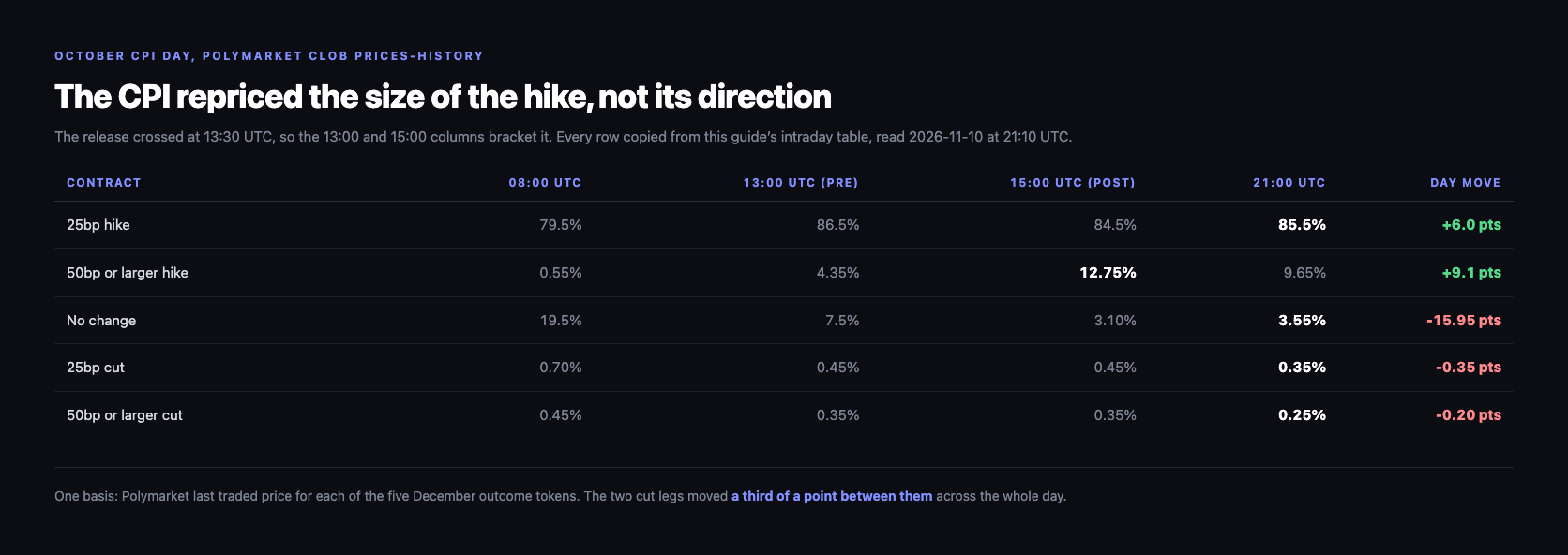
Most coverage of that print said it raised the odds of a December hike. Measured against the venue's own hourly history, that is only half right, and the less interesting half. Here is the whole day on Polymarket's December ladder.
| Contract | 08:00 UTC | 13:00 UTC (pre-release) | 15:00 UTC (post-release) | 21:00 UTC (now) | Day move |
|---|---|---|---|---|---|
| 25bp hike | 79.5% | 86.5% | 84.5% | 85.5% | +6.0 pts |
| 50bp or larger hike | 0.55% | 4.35% | 12.75% | 9.65% | +9.1 pts |
| No change | 19.5% | 7.5% | 3.10% | 3.55% | -15.95 pts |
| 25bp cut | 0.70% | 0.45% | 0.45% | 0.35% | -0.35 pts |
| 50bp or larger cut | 0.45% | 0.35% | 0.35% | 0.25% | -0.20 pts |
Polymarket CLOB prices-history, interval=1w and fidelity=60, for all five December outcome tokens. The CPI release crossed at 13:30 UTC, so the 13:00 and 15:00 columns bracket it. Read 2026-11-10 at 21:10 UTC.
Look at the hour that contains the release. The 50bp bucket roughly tripled, from 4.35% to 12.75%, while the 25bp bucket fell two points. The no-change leg halved. That is not the market becoming more sure the Fed will move. It is the market becoming more sure the Fed will move *harder*, and taking the probability out of the quarter-point bucket to pay for it.
There is a second move on that table that I cannot pin to a catalyst, and I would rather say so than guess. Between 08:00 and 10:00 UTC, hours before the release, no change went from 19.5% to 6.5% and the 50bp leg went from 0.55% to 4.15%. That is a European-session repricing with no US data behind it, and anyone telling you exactly why is reverse-engineering a story from a chart.
One more wrinkle from the release itself, and it matters for anyone comparing this print to last year's. The BLS published no 12-month change for October at all, because it did not collect survey data for October 2025 during a lapse in appropriations. So any page quoting an October year-over-year CPI figure has either computed it from a gap or borrowed September's. I use three-month annualised rates below for exactly this reason.
The Fed's Own Dot Plot Already Pencilled In December
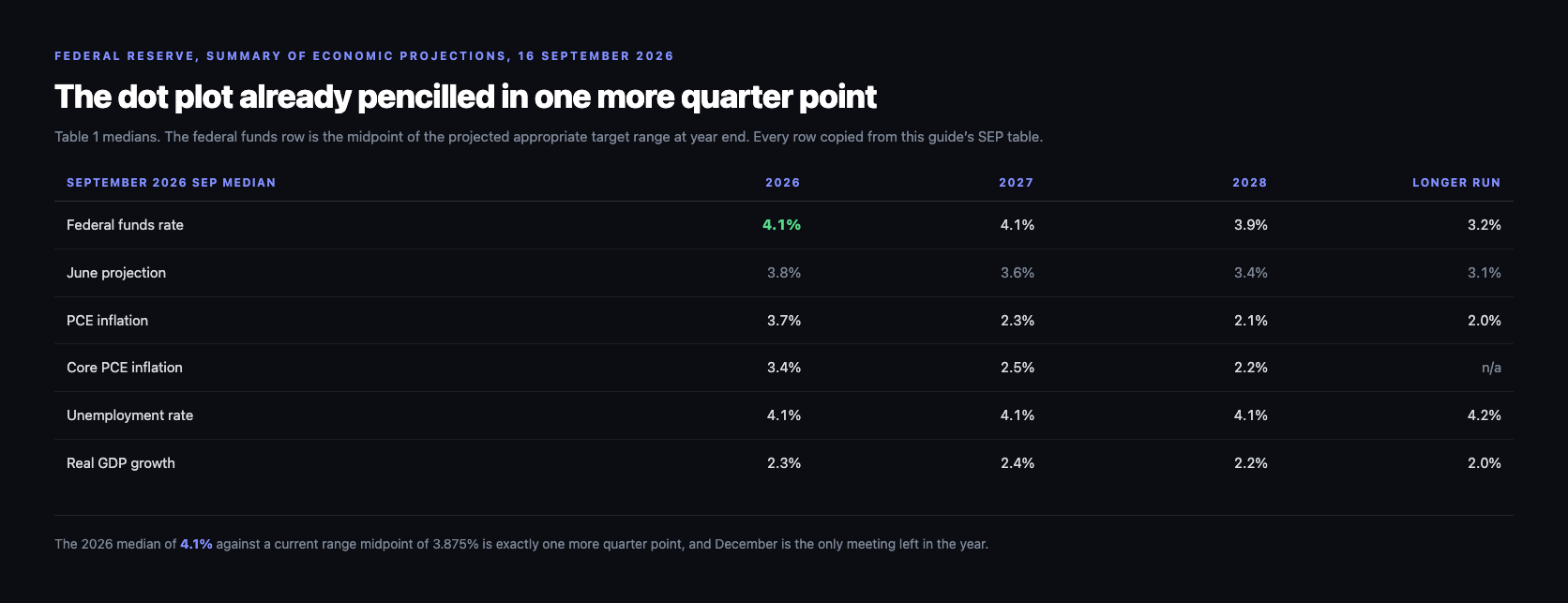
The strongest argument against a December cut is not a market price at all. It is the committee's own arithmetic, published in September and not revised since. The September 2026 Summary of Economic Projections put the median federal funds rate at the end of 2026 at 4.1%.
| September 2026 SEP median | 2026 | 2027 | 2028 | Longer run |
|---|---|---|---|---|
| Federal funds rate | 4.1% | 4.1% | 3.9% | 3.2% |
| June projection | 3.8% | 3.6% | 3.4% | 3.1% |
| PCE inflation | 3.7% | 2.3% | 2.1% | 2.0% |
| Core PCE inflation | 3.4% | 2.5% | 2.2% | n/a |
| Unemployment rate | 4.1% | 4.1% | 4.1% | 4.2% |
| Real GDP growth | 2.3% | 2.4% | 2.2% | 2.0% |
Federal Reserve, Summary of Economic Projections, September 16, 2026, Table 1 medians. The federal funds row is the midpoint of the projected appropriate target range at year end.
Run that against where policy actually sits. The target range is 3.75% to 4.00%, a midpoint of 3.875%, after the committee raised it by a quarter point in September. A 25bp increase takes the midpoint to 4.125%, which rounds to the 4.1% median exactly. The September dots contained precisely one more hike in 2026, and after October passed without one, December is the only meeting left to deliver it.
Kalshi runs a market on the December dot plot itself, since the December meeting carries a fresh SEP. Its ladder puts the end-2026 median above 4.0% at a 77% midpoint and above 4.1% at only 9.5%, which implies the market expects the December median to land on 4.1% and stop there. I would treat those two numbers gently: the strikes trade on books of 729 and 2,336 contracts against spreads of 7 and 8 cents, and a couple of the adjacent strikes are not even monotonic. The direction is informative, the decimals are not.
If you want the dot plot on its own terms rather than as a cut argument, this site's December dot plot preview works through the 2027 dots, which are where the genuine news will be on the 9th.
Why a Cut Was Never a Live Possibility at This Meeting
A rate cut needs one of two things: inflation falling back to target, or a labour market deteriorating fast enough to override inflation. Neither is happening in the data the committee will have on the table on December 8.
| Indicator | Latest | Period | 3-month annualised | Fed's 2026 SEP median |
|---|---|---|---|---|
| Headline CPI | +0.4% m/m | October 2026 | 5.72% | n/a |
| Core CPI | +0.3% m/m | October 2026 | 3.75% | n/a |
| Core PCE inflation | 3.12% y/y | September 2026 | 2.90% | 3.4% |
| Unemployment rate | 4.1% | October 2026 | n/a | 4.1% |
| Nonfarm payrolls | +165,000 | October 2026 | +137,000 avg | n/a |
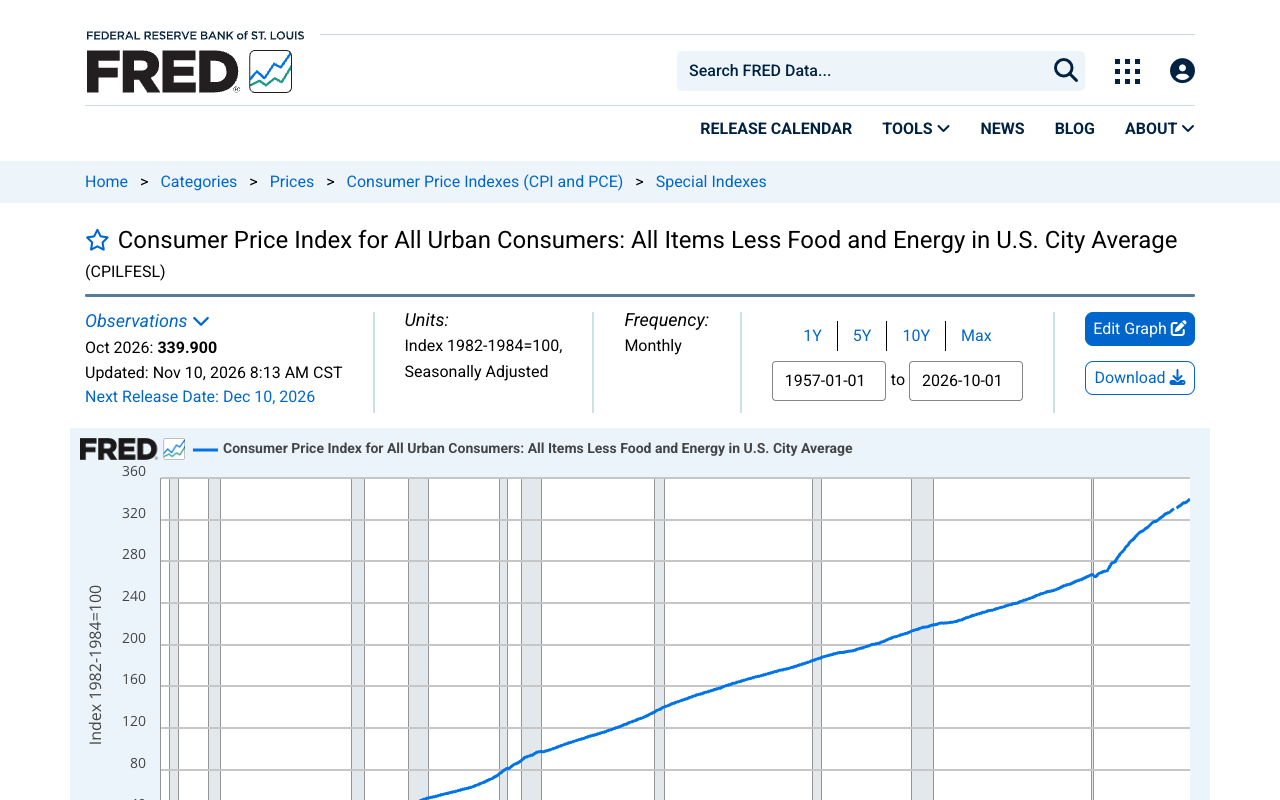
Computed from FRED series CPIAUCSL, CPILFESL, PCEPILFE, UNRATE and PAYEMS, read 2026-11-10. Three-month annualised is the compounded three-month change expressed at an annual rate. Core PCE year-over-year is used because October PCE is not yet published.
Headline inflation running at 5.72% annualised over three months is not a cutting environment under any framework the Fed has described. Core is cooler at 3.75% but still comfortably above the 2% objective, and core PCE, the gauge the objective is actually defined against, has been sitting near 3% rather than drifting down.
The labour market gives the cut camp nothing either. Unemployment at 4.1% is exactly the committee's own September projection for the end of the year, payrolls added 165,000 in October, and the three-month average is 137,000. That is a labour market in balance, not one in distress.
Then there is the vote itself, which is the part most pages skip. At the October 27-28 meeting the committee held the range at 3-3/4 to 4 percent by 10 votes to 2, and both dissenters, Governor Lisa Cook and Cleveland Fed President Beth Hammack, preferred an immediate quarter-point increase. The statement said plainly that inflation remains elevated. A committee whose only dissents are hawkish is not a committee four weeks from a cut.
How These Cut Contracts Actually Settle
Before you act on a 0.35%, check what it is 0.35% of. The two venues frame the same decision differently, and the difference matters at the edges.
Polymarket resolves on the change in the upper bound of the target range versus the level immediately before the December meeting, rounded up to the nearest 25bp bracket. So "25 bps decrease" means the upper bound goes from 4.00% to 3.75%. It is a market on the move, not on the level, which is why its ladder reads cleanly against the Fed's own language.
Kalshi frames each leg as a question about what the Fed does at that meeting, with a separate contract per size and direction, closing on December 9. Its legs are therefore exclusive in the same way, and the five midpoints in my first table sum to 101%, which is as coherent as a one-cent tick permits.
One practical consequence: a 0c bid on Kalshi is not the same statement as a 0.3c bid on Polymarket. Kalshi quotes in whole cents, so its floor is 1% of a contract and anything below that reads as zero. Polymarket's tenth-of-a-cent tick is why it can show 0.35% and 0.25% as different numbers at all. When you see Kalshi at 0.5% and Polymarket at 0.35%, that is a tick-size artifact, not a disagreement.
When the First Cut Is Actually Priced
"Will the Fed cut rates" is a better question with a horizon attached. Kalshi runs a cumulative series, Next Fed rate cut, that asks whether the next change in the target range is a cut announced before a given date. That is the framing a reader wants and almost nobody publishes.
| Question | Venue | Bid / ask | Mid | Lifetime volume | Read |
|---|---|---|---|---|---|
| Cut at the December 8-9 meeting | Polymarket | 0.3c / 0.4c | 0.35% | $3,877,414 | Deep, trust it |
| Cut at the December 8-9 meeting | Kalshi | 0c / 1c | 0.5% | 816,587 contracts | At the tick floor |
| Zero cuts in all of 2026 | Polymarket | 98.0c / 98.2c | 98.1% | $9,556,306 | Implies 1.9% on one or more |
| Any cut before 2027 | Kalshi KXRATECUT | 1.6c / 1.7c | 1.65% | 1,726,782 contracts | Deepest book on the question |
| Cut before 2027 | Kalshi KXFEDCUT | 1c / 3c | 2.0% | 1,060 contracts | Thin, read the bid |
| Cut before July 2027 | Kalshi KXFEDCUT | 37c / 40c | 38.5% | 977 contracts | Thin, 3-point spread |
| Cut before 2028 | Kalshi KXFEDCUT | 58c / 64c | 61.0% | 1,959 contracts | Thin, 6-point spread |
Polymarket Gamma events 770450 and 51456, Kalshi KXRATECUT-26DEC31 and the KXFEDCUT ladder, all pulled 2026-11-10 between 21:05 and 21:15 UTC. Polymarket volume is lifetime dollars; Kalshi volume is lifetime contracts.
Three independent books answer the rest-of-2026 question and they land in the same place. Polymarket's 98.1% on zero cuts leaves 1.9% for one or more, Kalshi's deep any-cut contract says 1.65%, and the December meeting itself prices at 0.35%. The gap between 1.65% and 0.35% is the unscheduled-cut window between December 10 and 31, which is exactly what you would expect it to be.
Push the horizon out and the picture changes, slowly. A cut before July 2027 prices at 38.5%, and a cut before 2028 at 61%. Those are real probabilities rather than rounding, but they come off books that have traded under 2,000 contracts in their lives against spreads of 3 to 6 points. I would quote the number and the spread together every time, and this site's 2027 cut-odds piece goes through that ladder meeting by meeting.
Note what the cumulative ladder implies about sequencing. The market is not pricing a pause and then a cut. It is pricing another hike in December, a coin-flip January, and the first cut somewhere in the second half of 2027. Polymarket's January 2027 ladder reads 50.5% no change against 47.5% for a 25bp hike, and March 2027 reads 44% against 47%.
What Would Have to Change for a December Cut
A 0.35% probability is not zero, and it is worth knowing what the market thinks would have to break for it to pay. Between this morning and December 8 there is one more employment report and one more CPI print, plus the PCE release for October.
- A labour-market shock, not a softening. Unemployment at 4.1% would need to jump by several tenths in one report, or payrolls would need to print deeply negative with downward revisions attached. A 50,000 miss does not do it; the October report already came in at 165,000.
- A credit or funding event. Every inter-meeting cut in the Fed's modern history followed a market dislocation rather than a data release. This is the scenario the whole-year contracts price above the meeting contract, and it is worth about 1.3 points of probability.
- An inflation collapse that has not started. Core at 3.75% annualised over three months would need two consecutive very soft prints to get near target, and the November CPI lands too late to be the second one.
- A committee that reverses its own dissents. Two members wanted to hike in October. For a cut to pass in December, those two plus most of the majority would have to change direction inside six weeks, with inflation above target and unemployment at their own projection.
None of those is impossible, and that is precisely what 0.35% means. It is not a forecast that the world is stable. It is a price on a specific, identifiable set of tail events, and the market is charging a third of a cent for them.
How to Read the December 9 Decision as It Happens
The decision drops at 2:00 p.m. ET on Wednesday December 9, and because this is a projection meeting the dot plot arrives with it rather than three weeks later. That makes the next few minutes unusually dense.
| Date (2026) | Event | Why it moves the ladder |
|---|---|---|
| Nov 10 | October CPI (released) | Already done: 50bp leg 4.35% to 12.75% across the hour |
| Dec 4 | November employment report | The only labour print left before the meeting |
| Dec 8-9 | FOMC meeting | Statement 2:00 p.m. ET Wednesday, with a fresh SEP |
| Dec 9 | Dot plot and press conference | The 2027 median is the number with news in it |
| Jan 26-27 | Next FOMC meeting | Currently 50.5% no change against 47.5% for a 25bp hike |
FOMC dates from the Federal Reserve meeting calendar. January 2027 odds from Polymarket Gamma event 770451, pulled 2026-11-10 at 21:07 UTC. Release dates for data are the scheduled dates as published.
If you are watching the ladder live, the signal is not the 25bp leg, which is already at 85.5% and has limited room. Watch the 50bp leg and the no-change leg. Those two carry almost all of the remaining uncertainty, and today showed they move against each other rather than together.
For the broader setup, the Fed decision odds hub tracks every open contract on this meeting next to the official rate, the FOMC calendar carries the full 2026 and 2027 schedule, and the track record page shows how these contracts have resolved against their pre-meeting prices so far this cycle.
Frequently asked questions
Will the Fed cut rates in December 2026?
Almost certainly not. Polymarket prices a 25bp cut at the December 8-9 meeting at 0.35% and a larger cut at 0.25%, so 0.6% for a cut of any size. Kalshi's two cut legs are both quoted 0c bid against 1c offered, its tick floor. The deepest books on both venues instead price a 25bp hike at 85.0% to 85.5%.
What are the odds of a Fed rate cut in 2026 overall?
About 1.65% to 1.9% for the whole remainder of the year. Kalshi's any-cut-before-2027 contract trades at a 1.65% midpoint on 1,726,782 contracts of lifetime volume, and Polymarket prices zero cuts in 2026 at 98.1% on $9.56m, leaving 1.9% for one or more. Both sit slightly above the December meeting's own 0.35% because they stay open for an unscheduled cut later in the month.
Is the Fed going to hike instead of cut in December?
That is what both venues price. A 25bp increase is 85.5% on Polymarket and 85.0% on Kalshi, and a 50bp or larger increase is 9.65% and 10.5%. The Fed's own September projections put the median end-2026 rate at 4.1% against a current range midpoint of 3.875%, which is exactly one more quarter point, and December is the last meeting of the year.
How did the October CPI report change the December odds?
It moved the size of the hike rather than its direction. Across the 8:30 a.m. ET release on November 10, Polymarket's 50bp bucket went from 4.35% to 12.75% while the 25bp bucket fell from 86.5% to 84.5% and no change halved from 7.5% to 3.10%. Headline CPI rose 0.4% on the month and core rose 0.3%, both above consensus.
Why is there no 12-month CPI figure for October 2026?
Because the BLS did not collect survey data for October 2025 during a lapse in appropriations, so there is no year-ago base to compare against. The November 10, 2026 release says so explicitly and publishes monthly changes only. Three-month annualised rates are the cleanest read for now: 5.72% headline and 3.75% core as of October.
When is the first Fed rate cut priced?
The second half of 2027 on the only cumulative ladder that quotes it. Kalshi prices a cut before July 2027 at 38.5% and a cut before 2028 at 61%, both on books that have traded under 2,000 contracts against 3 to 6 point spreads. Per-meeting prices are much smaller, and Polymarket's January 2027 ladder still reads 47.5% for a hike against 50.5% for no change.
What would have to happen for the Fed to cut in December?
A labour-market shock or a credit event, not a soft data print. Unemployment sits at 4.1%, exactly the Fed's own 2026 projection, payrolls added 165,000 in October, and core inflation is running at 3.75% annualised. On top of that, the only two dissents at the October meeting were from members who wanted a hike, so a cut would require the committee to reverse itself in six weeks.
Do Polymarket and Kalshi settle these cut markets the same way?
Close enough to compare, with one caveat. Polymarket resolves on the change in the upper bound of the target range versus the pre-meeting level, rounded to the nearest 25bp bracket, and its event runs to December 10. Kalshi asks what the Fed does at the meeting and closes on December 9. Kalshi quotes in whole cents, so anything under 1% reads as zero there while Polymarket can show 0.35%.
Sources
- Federal Reserve, FOMC calendars and meeting dates (December 8-9, 2026, with a Summary of Economic Projections)
- Federal Reserve, FOMC statement of October 28, 2026 (range held at 3-3/4 to 4 percent, 10-2 vote, Cook and Hammack dissenting for a hike)
- Federal Reserve, Summary of Economic Projections, September 16, 2026 (median end-2026 federal funds rate 4.1%)
- Bureau of Labor Statistics, Consumer Price Index for October 2026, released November 10, 2026
- Polymarket, Fed Decision in December 2026 (the market quoted throughout)