Fed Rate Hike Odds December 2026: Skip, Then Hike?

Everyone is watching the wrong meeting. The September 16 decision has been settled business for a week, priced at 88.5% for a quarter point hike, and the interesting question is what the Federal Reserve does with the two meetings that come after it. Fed rate hike odds for December 2026 currently sit near 60%, and October sits near 38%, which is a specific and slightly strange shape.
That shape matters because the difference between one hike this year and two is about $30 billion a year in interest on the floating rate corporate debt stack, and roughly a quarter point on every mortgage quote that keys off the front end. I pulled every outcome contract for all three remaining meetings from Polymarket's Gamma API and Kalshi's public market endpoints this evening, ran the implied path, and set it against the Fed's own June projection table.
The short version: markets price a hike, then a skip, then another hike. Below is where that comes from, where it could break, and the one inflation number that decides it.
December 2026 Fed Rate Hike Odds Right Now
Here is the full outcome ladder for the December 8-9 meeting, from both venues, captured September 15, 2026 at 21:20 UTC. Polymarket quotes a last traded price per outcome. Kalshi quotes a live bid and ask, so I have shown the midpoint, which is the fairer comparison.
| December 8-9 outcome | Polymarket | Kalshi bid/ask | Kalshi mid |
|---|---|---|---|
| Hike 25 bps | 59.5% | 60 / 62 | 61.0% |
| No change | 36.5% | 33 / 38 | 35.5% |
| Hike more than 25 bps | 1.5% | 1 / 2 | 1.5% |
| Cut 25 bps | 3.8% | 1 / 2 | 1.5% |
| Cut more than 25 bps | 0.8% | 0 / 1 | 0.5% |
| Implied total | 102.0% | n/a | 100.0% |
Polymarket event "Fed Decision in December?" and Kalshi series KXFEDDECISION-26DEC. Captured September 15, 2026, 21:20 UTC. The Polymarket column sums to 102% because each outcome is a separate binary contract and the spread is the house's.
Normalise that 102% away and Polymarket's real probability of any hike in December is 59.8%, no change is 35.8%, and some kind of cut is 4.5%. So the honest one line answer to "will the Fed hike in December" is that it is close to a coin flip weighted about three to two in favour.
One caveat on the December book that nobody quoting these numbers mentions. The December event has traded about $837,000 of volume against $180 million on the September event. It is a real market, but it is a thin one, and a single large order moves it several points. Treat September's 88.5% as a hard consensus and December's 59.5% as a considered opinion.
The Path Markets Actually Price: Hike, Skip, Hike
Reading one meeting in isolation is how people get this wrong. The three remaining decisions are separate contracts, so you can line them up and see the shape of the whole year end.
| Meeting | Dates | P(hike) | P(no change) | P(cut) | Expected move |
|---|---|---|---|---|---|
| September | Sep 15-16 | 89.3% | 10.5% | 0.2% | +22.5 bps |
| October | Oct 27-28 | 37.9% | 59.6% | 2.5% | +9.0 bps |
| December | Dec 8-9 | 59.8% | 35.8% | 4.5% | +14.0 bps |
| All three | +45.5 bps |
Probabilities normalised to sum to 100% per meeting, from Polymarket Gamma outcome prices captured September 15, 2026, 21:20 UTC. Expected move treats the "more than 25 bps" buckets as 50 bps.
The middle row is the story. October is the only one of the three where no change is the favourite, and it is the favourite by a wide margin. Markets are not pricing a steady march upward. They are pricing a hike, a deliberate pass, and then a second hike seven weeks later.
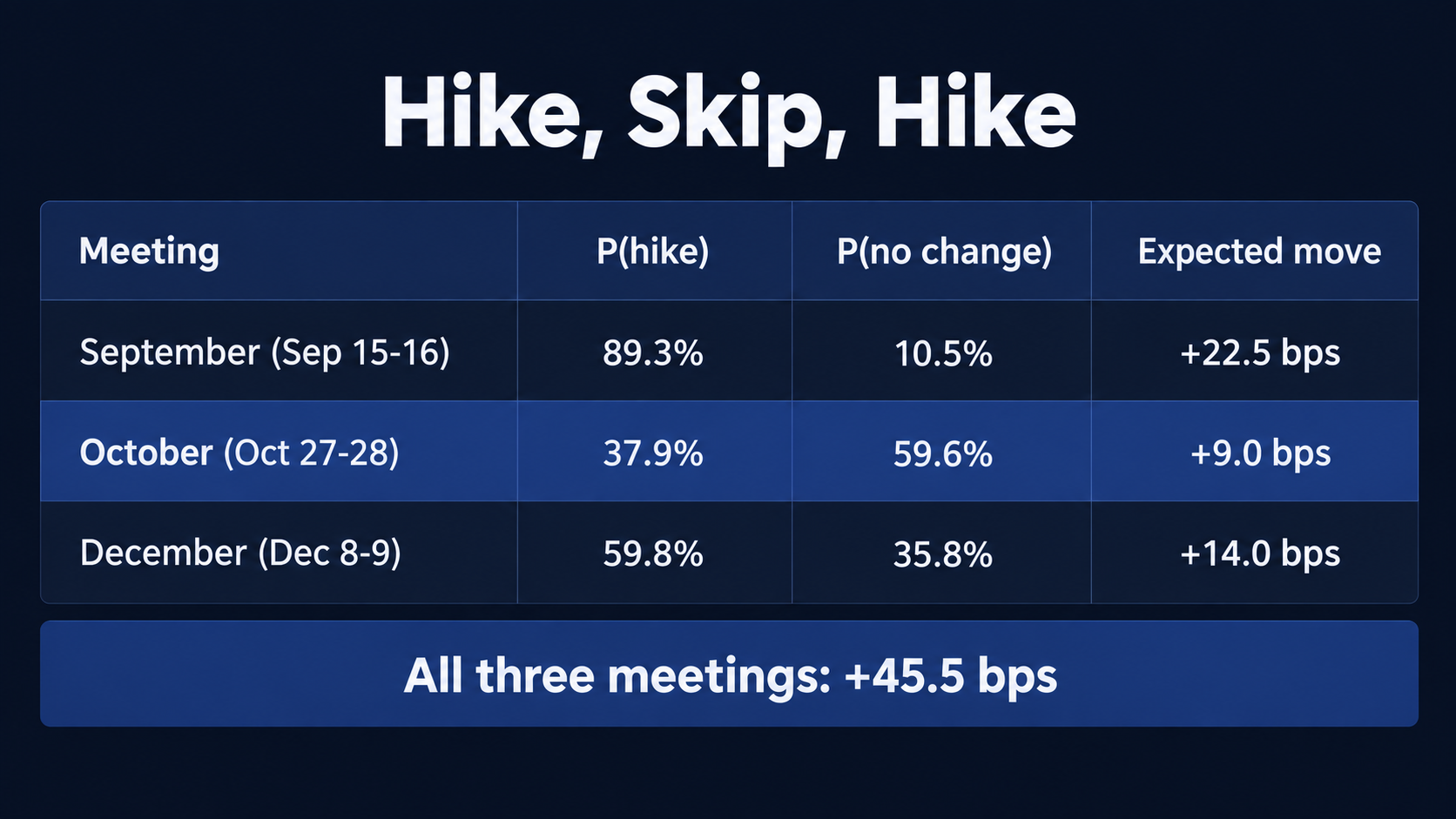
Worth saying plainly: these are three independent binary books, not a joint distribution. You cannot multiply them to get a clean probability of exactly two hikes, because the same news that lifts October lifts December. The expected move is the honest summary statistic here, and it comes to about 1.8 quarter point hikes.
Where the Implied Fed Funds Rate Ends 2026
The target range is 3.50% to 3.75%, a midpoint of 3.625%, and it has been there since December 2025. Adding each meeting's expected move in sequence gives the market implied path.
| After | Expected move | Implied midpoint | Implied range |
|---|---|---|---|
| Today | 3.625% | 3.50-3.75% | |
| September 16 | +22.5 bps | 3.850% | 3.75-4.00% |
| October 28 | +9.0 bps | 3.940% | 3.75-4.00% |
| December 9 | +14.0 bps | 4.080% | 4.00-4.25% |
| Fed's own June median | 3.800% | 3.75-4.00% |
Market implied path from Polymarket outcome prices, September 15, 2026. The June median is the Federal Reserve's published Summary of Economic Projections, June 17, 2026.
So the market ends 2026 at 4.08% and the Fed's own June median ended it at 3.8%. That is a 28 basis point gap, and it is wider than it looks, because a fed funds midpoint of 3.8% is not a thing the target range can produce. As I worked through in the September dot plot preview, 3.8% is the rounded average of a committee split nine to nine between 3.625% and 3.875%.
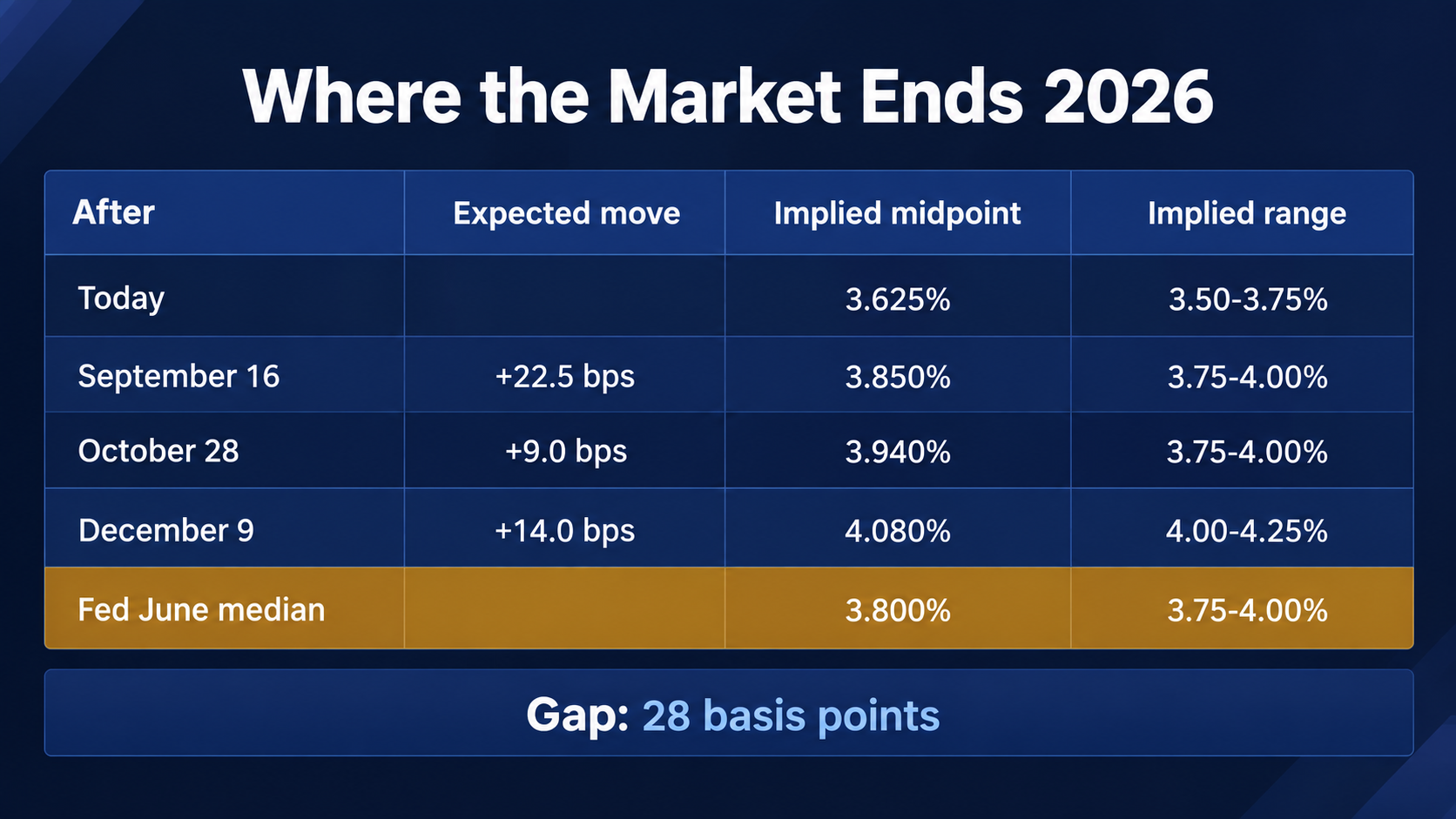
Put less politely: in June, half the committee did not want to hike at all, and the market now prices nearly two hikes. One of those two views is going to look silly by Christmas. The September projections land tomorrow and will tell us which way the dots have moved.
Why October Is the Meeting Markets Expect the Fed to Skip
Three reasons show up in the pricing, and only one of them is about the economy.
- October has no projections. Under the current calendar the March, June, September and December meetings publish a Summary of Economic Projections. October 27-28 does not. A committee this divided prefers to move when it can show its work, and the 2026 FOMC calendar gives it that chance in December.
- Back to back hikes are a statement. Moving in September and again in October would be the first consecutive hikes since 2023 and would read as the start of a cycle rather than an adjustment. Warsh has been careful to frame a September move as a correction of policy that is not restrictive enough, which is a different message.
- There is almost no new data. Between the October decision and the September one there are two CPI prints and one jobs report. Between October and December there are two more of each plus a full quarter of GDP. December is simply where the information is.
None of that makes October dead. A 37.9% chance is a real chance, and it is the bucket that moves fastest if the September CPI print in mid October comes in hot. But the market's base case is that the Fed uses October to watch.
Core Inflation Is the Number That Decides December
Here is the tension at the centre of this whole year, and it is why I think the December contract is the most interesting thing on the board.
| Measure | Latest reading | Fed's June 2026 projection | Gap |
|---|---|---|---|
| Headline CPI, 12 month | 3.4% (August) | PCE 3.6% Q4/Q4 | Broadly in line |
| Core CPI, 12 month | 2.4% (August) | Core PCE 3.3% Q4/Q4 | Roughly 0.9 pts below |
| Monthly headline CPI | +0.4% (August) | n/a | Up from +0.1% in July |
| Unemployment rate | 4.1% (August) | 4.3% Q4 2026 | 0.2 pts stronger |
| Nonfarm payrolls | +162,000 (August) | n/a | Beat consensus of ~53,000 |
CPI and payrolls from the Bureau of Labor Statistics releases of September 11 and September 4, 2026. Projections from the Federal Reserve's June 17, 2026 SEP.
Read the second row carefully. Core CPI is running at 2.4% while the Fed's June projection has core PCE at 3.3% for the fourth quarter. The two gauges are not the same measure, and the difference cuts the wrong way for the Fed's forecast: core PCE normally prints a few tenths below core CPI, not nine tenths above it. The difference between CPI and PCE is mostly weighting and scope, not direction.
What that means in plain terms is that the Fed's June forecast assumed the energy shock would bleed into underlying prices, and so far it has not. Headline is at 3.4% because oil crossed $100 a barrel after the supply disruption that began in February. Core, which strips energy out, is sitting closer to target than at any point this cycle.
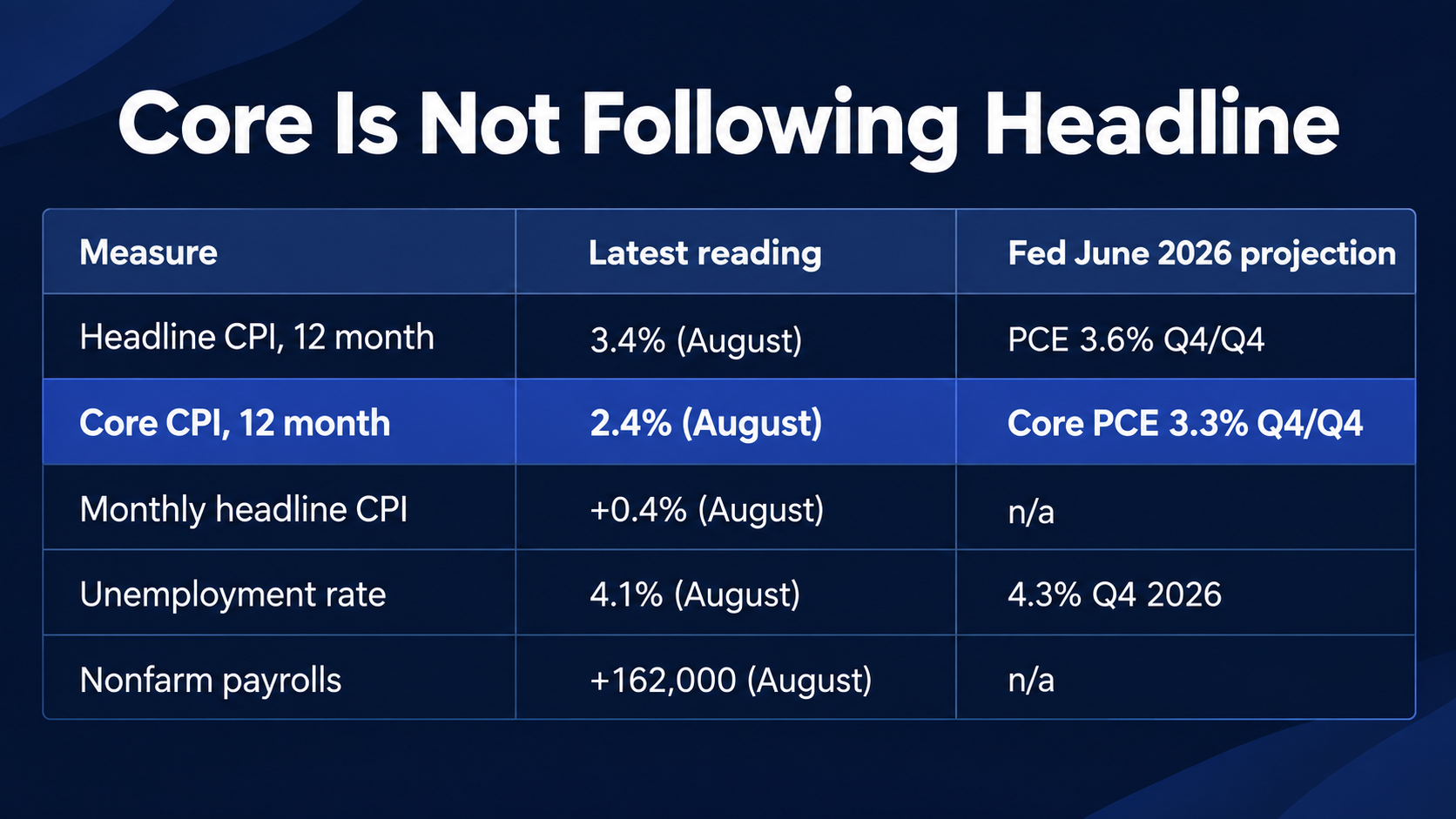
This is why December is 60% and not 85%. If core CPI is still near 2.4% when the December meeting arrives, the case for a second hike rests entirely on headline inflation and on credibility, and several members will not vote for that. If core starts climbing toward 3%, December stops being a coin flip very quickly.
Polymarket vs Kalshi: How Close Are the Two Venues?
I check this every time because a persistent gap between the two books is usually the most reliable signal that one of them is stale. Tonight there is no gap worth trading.
| Meeting | Polymarket hike | Kalshi hike (mid) | Spread |
|---|---|---|---|
| September 16 | 88.5% | 87.5% | 1.0 pt |
| October 28 | 37.5% | 37.5% | 0.0 pts |
| December 9 | 59.5% | 61.0% | 1.5 pts |
Polymarket last traded price for the 25 bps increase outcome against the Kalshi bid/ask midpoint for the equivalent contract, both captured September 15, 2026, 21:20 UTC.
A one point spread on a market with a one cent tick is noise. October matching to the decimal across two venues with different users, different collateral and different regulators is a decent sign the 60/40 skip call is genuinely where informed money sits, rather than an artefact of one thin book.
The one structural difference to keep in mind: Kalshi's December contracts quote a 33 to 38 spread on no change, which is five cents wide. Polymarket's equivalent is tighter. If you are comparing headline numbers from the two sites without looking at the spread, you will invent disagreements that are not there. We keep the live comparison running on the Fed decision odds page.
How Divided the Committee Gets by December
There is a market almost nobody looks at that I think is more informative than the rate contracts: the number of dissenting votes. The July 28-29 meeting held rates 9 to 3, with Beth Hammack, Neel Kashkari and Lorie Logan all dissenting in favour of a 25 basis point hike.
| Dissenting votes | September | December | Change |
|---|---|---|---|
| 0 | 35.5% | 17.5% | Halved |
| 1 | 24.0% | 16.6% | Down |
| 2 | 24.0% | 23.9% | Flat |
| 3 | 12.0% | 24.0% | Doubled |
| 4 or more | 6.5% | 22.5% | More than tripled |
| Two or more | 41.7% | 67.4% | Up 25.7 pts |
Polymarket "How many dissent at the September / December Fed meeting?" events, captured September 15, 2026, 21:20 UTC. The December book is thin at roughly $7,400 of volume, so read it as a sketch rather than a precise measurement.
The pattern is unambiguous even allowing for the thin book. Markets think a unanimous December is about half as likely as a unanimous September, and four or more dissents go from a tail risk to a one in four shot. A committee that hikes in September and skips October does not converge over the autumn. It argues.
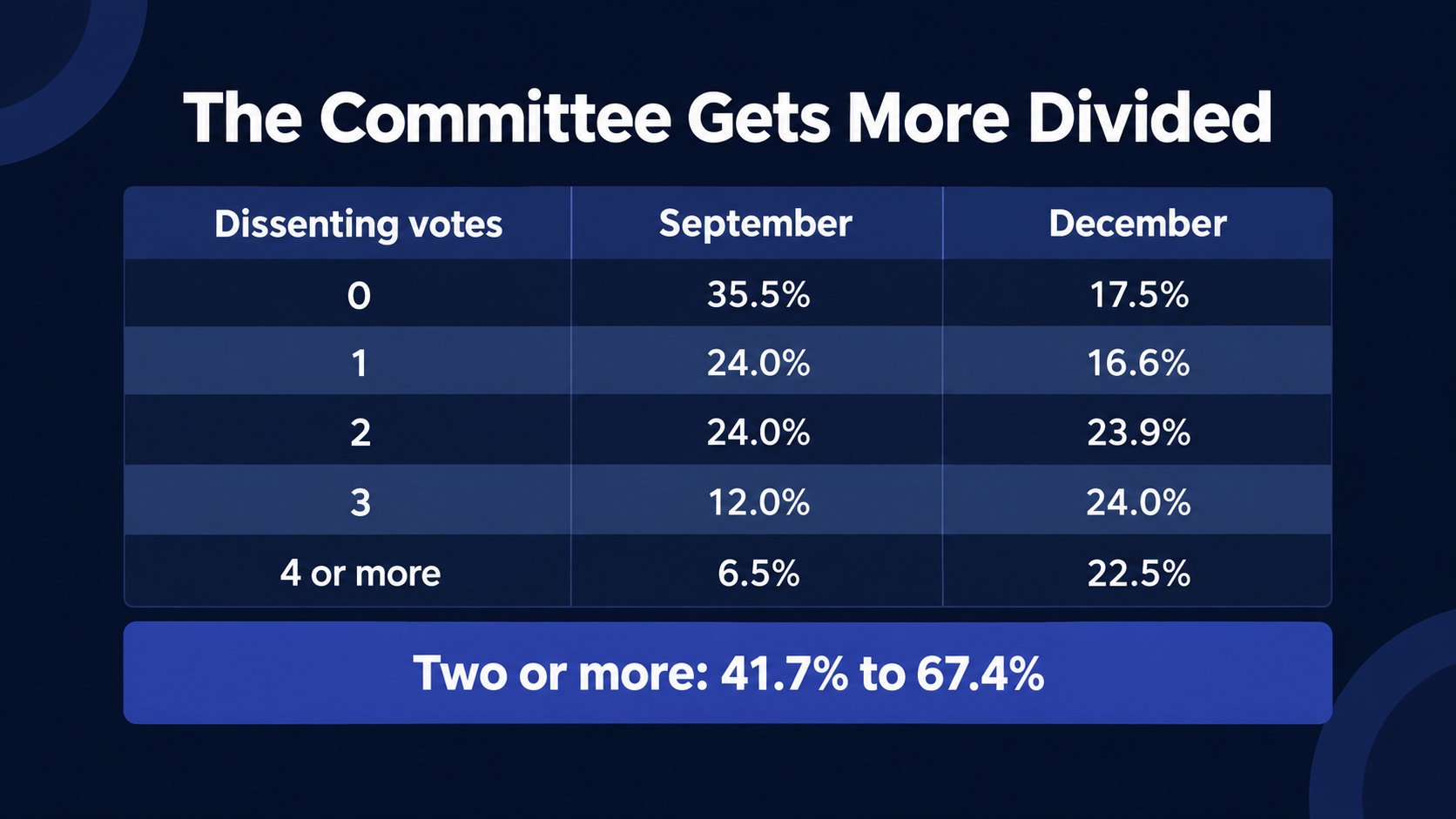
That is a coherent story rather than a contradiction. The hawks who dissented in July get their hike in September. If core inflation stays where it is, the doves then have a case for stopping, and by December you have both camps voting their conscience in opposite directions on the same decision.
What Would Move December Rate Hike Odds Before the Meeting
Between now and December 9 there are five scheduled releases that actually matter, plus one unscheduled thing.
- Tomorrow's dot plot. The September SEP is the first look at where this committee stands since June's nine to nine split. If the median for end-2026 moves to 3.9% or above, the market's 4.08% stops looking aggressive and December firms up.
- September and October CPI. Core is the line to watch, not headline. Two consecutive core prints above 0.3% month on month would put October back in play and make December the base case rather than a coin flip.
- The October and November jobs reports. Payrolls have averaged about 71,000 a month over the last three months, up from roughly 38,000 as of July. A return to the thirties gives the doves their argument back.
- The oil price. Headline inflation is where it is because of a supply disruption. If crude falls back under $90, headline converges down toward core and the credibility argument for hiking weakens considerably.
- Warsh's press conferences. He has moved these markets more than any data point this year. His Jackson Hole remarks on August 28 roughly doubled September hike odds inside a week.
- Anything from the Treasury or the White House. Political pressure on the Fed has been a live variable all year and it is the one input with no release calendar.
If you want to check how well these markets have actually called it rather than taking my word for the framing, our accuracy scorecard tracks every resolved Fed contract against the outcome.
My own read, for what it is worth: I think October at 38% is slightly too high and December at 60% is about right. The committee has a projections meeting in December and a divided room, and if I were trying to hold nineteen people together I would not spend a meeting with no SEP to hide behind on a hike I could take seven weeks later.
Frequently asked questions
What are the odds of a Fed rate hike in December 2026?
As of September 15, 2026, Polymarket prices a 25 basis point hike at the December 8-9 meeting at 59.5% and Kalshi's equivalent contract sits at a 61% midpoint. Normalised for the spread across all outcomes, that is a 59.8% chance of any hike, 35.8% for no change and 4.5% for a cut. These are live markets and the numbers move daily.
When is the December 2026 FOMC meeting?
The Federal Open Market Committee meets December 8-9, 2026, with the decision published at 2:00 pm Eastern on December 9 and the chair's press conference at 2:30 pm. It is a projections meeting, so it also carries a Summary of Economic Projections and a new dot plot.
Will the Fed hike rates in October 2026?
Markets say probably not. No change is priced at 60.5% on Polymarket and 61.5% on Kalshi, against 37.5% for a 25 basis point hike on both venues. The main reason is that October 27-28 publishes no economic projections, and a divided committee generally prefers to move at a meeting where it can show its reasoning.
How high will the fed funds rate be at the end of 2026?
Chaining the expected move from each of the three remaining meetings gives a market implied midpoint of 4.08%, which corresponds to a target range of 4.00% to 4.25%. That is 45.5 basis points above the current 3.625% midpoint, or about 1.8 quarter point hikes. The Fed's own June 2026 median projection was 3.8%.
Why would the Fed hike when core inflation is only 2.4%?
Headline CPI is at 3.4% because of an energy supply shock, and core, which excludes energy, is at 2.4%. The case for hiking rests on preventing that headline reading from feeding into wage and price expectations, which is a credibility argument rather than a demand argument. That is exactly why the committee is split, and why the December contract trades near 60% rather than near 90%.
Is Polymarket or Kalshi more accurate on Fed decisions?
On current pricing there is nothing to choose between them. The two venues are within 1.5 points on all three remaining 2026 meetings and identical to the decimal on October. Kalshi is a CFTC regulated exchange available to US residents, while Polymarket carries far more volume on the near dated Fed contracts, roughly $180 million on the September event.
What is the dissent market and why does it matter?
Polymarket runs contracts on how many FOMC members vote against the decision. They matter because the vote count signals how durable a policy stance is. Markets currently price a 67.4% chance of two or more dissents in December against 41.7% in September, meaning traders expect the committee to become more divided, not less, as the year ends.
When did the Fed last raise interest rates?
The last increase of the previous cycle was in July 2023, which took the target range to 5.25% to 5.50%. Rates were then cut in stages to the current 3.50% to 3.75% range, where they have sat since December 2025. A September 2026 hike would be the first increase in more than three years.