Fed Rate Hike Odds October 2026: The Skip Just Flipped

The meeting everyone had written off is suddenly the interesting one. Three days ago the October 27-28 decision was priced as a comfortable skip, with no change leading 60.5% to 37.5%, and I said in last week's December preview that I thought 37.5% was slightly too high. Fed rate hike odds for October 2026 now sit at 56.5% on Polymarket. That is a 19 point move in three days on a market carrying $7.3 million of volume, and it is the largest single repricing of a Fed contract I have tracked this year.
This matters well beyond the prediction market. A quarter point in October rather than December pulls forward the repricing of every floating rate loan, corporate revolver and adjustable mortgage in the country by roughly six weeks, and it changes the shape of the front end of the curve into year end. I pulled the full outcome ladder for October, December and January from Polymarket's Gamma API and Kalshi's public market endpoints this afternoon, set them against the Federal Reserve's brand new Summary of Economic Projections, and re-ran the implied path.
The short version: the hike was expected, the unanimity was not, and the unanimity is what moved the market. Below is where the number sits, what caused the move, and the one thing that could unwind it before October 28.
October 2026 Fed Rate Hike Odds Right Now
Here is the full outcome ladder for the October 27-28 meeting from both venues, captured September 18, 2026 at 16:20 UTC. Polymarket quotes a last traded price per outcome. Kalshi quotes a live bid and ask, so I have shown the midpoint, which is the fairer comparison.
| October 27-28 outcome | Polymarket | Kalshi bid/ask | Kalshi mid |
|---|---|---|---|
| Hike 25 bps | 56.5% | 55 / 56 | 55.5% |
| No change | 43.5% | 42 / 44 | 43.0% |
| Hike more than 25 bps | 1.0% | 1 / 2 | 1.5% |
| Cut 25 bps | 0.7% | 0 / 1 | 0.5% |
| Cut more than 25 bps | 0.4% | 0 / 1 | 0.5% |
| Implied total | 102.0% | n/a | 101.0% |
Polymarket event "Fed Decision in October?" and Kalshi series KXFEDDECISION-26OCT. Captured September 18, 2026, 16:20 UTC. The Polymarket column sums to 102% because each outcome is a separate binary contract and the spread is the house's.
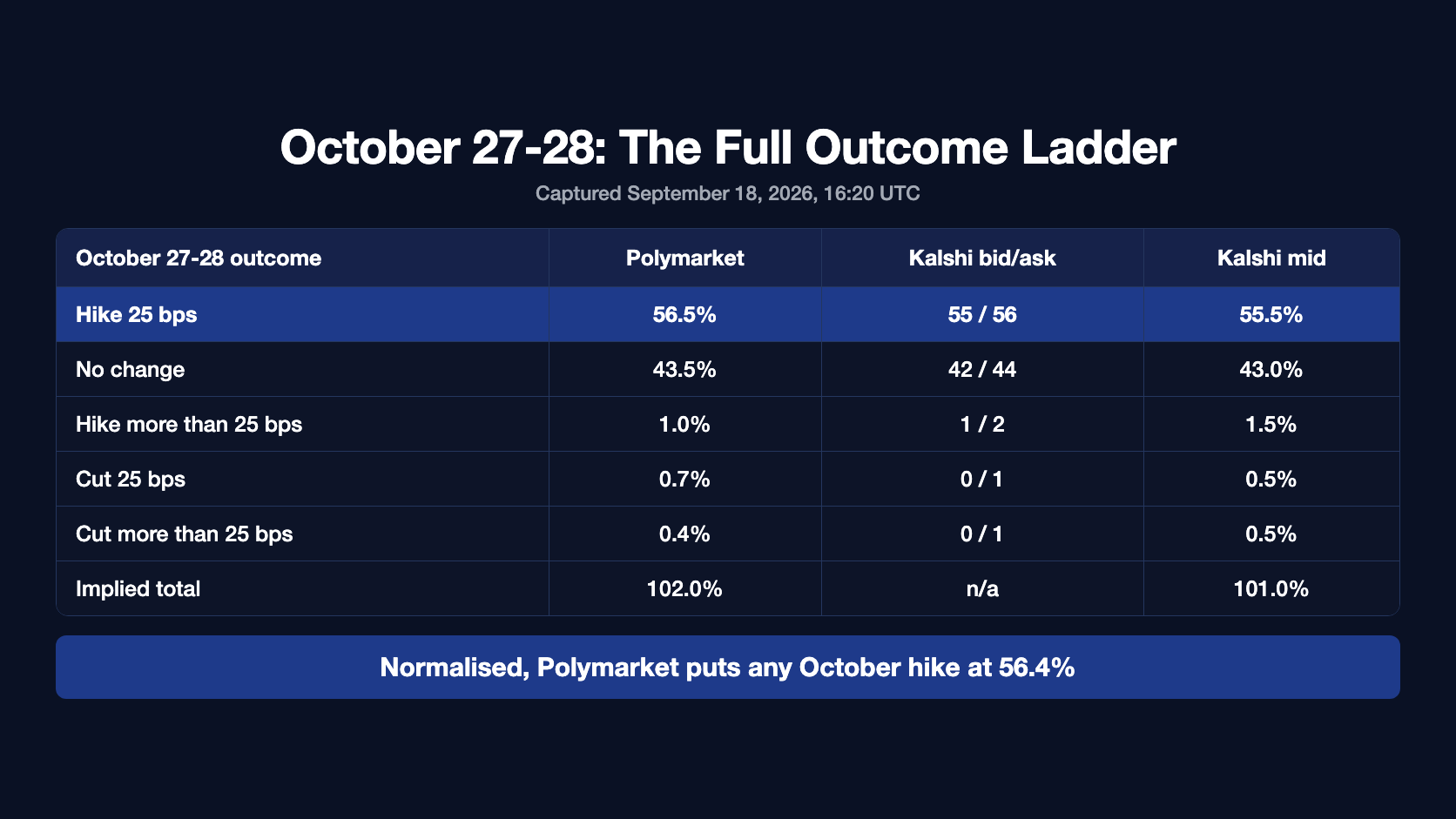
Normalise that 102% away and Polymarket's real probability of any hike in October is 56.4%, no change is 42.7%, and some kind of cut is 1.0%. So the honest one line answer to "will the Fed hike in October" is that it is close to a coin flip, tilted about four to three in favour of a move.
Two things are worth saying about the quality of this book, because they cut in opposite directions from the December market I wrote about last week. The October event has traded $7.3 million on Polymarket, which is nearly nine times December's $1.1 million, and Kalshi's October hike contract alone shows 261,277 contracts of open interest. This is not a thin market being pushed around by one order.
The other side of that: a market this liquid moving 19 points in three days is not noise being corrected. It is a genuine change of view, and it happened on a single afternoon.
How the September 16 Decision Repriced October
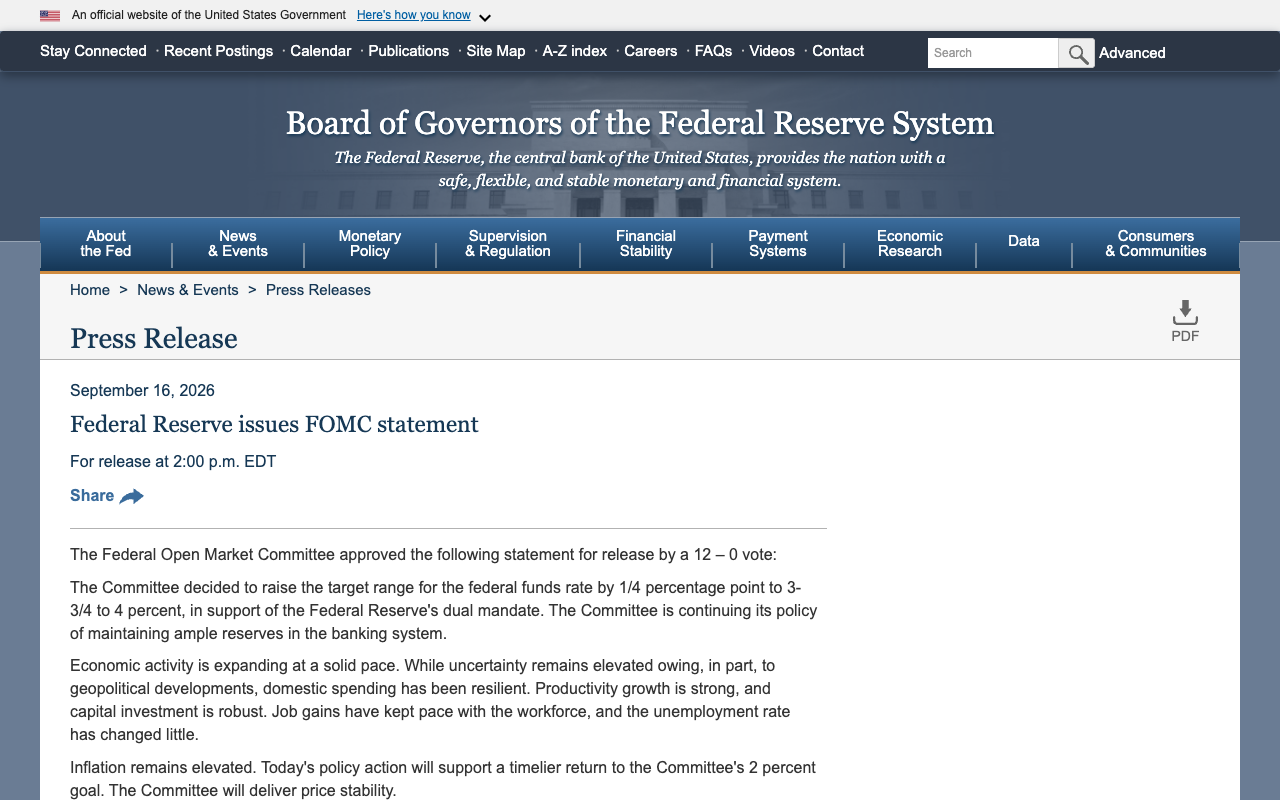
The Federal Open Market Committee raised the target range by 25 basis points on September 16 to 3.75% to 4.00%, the first increase since July 2023. That part was priced at 88.5% the day before and surprised nobody. The vote was 12-0.
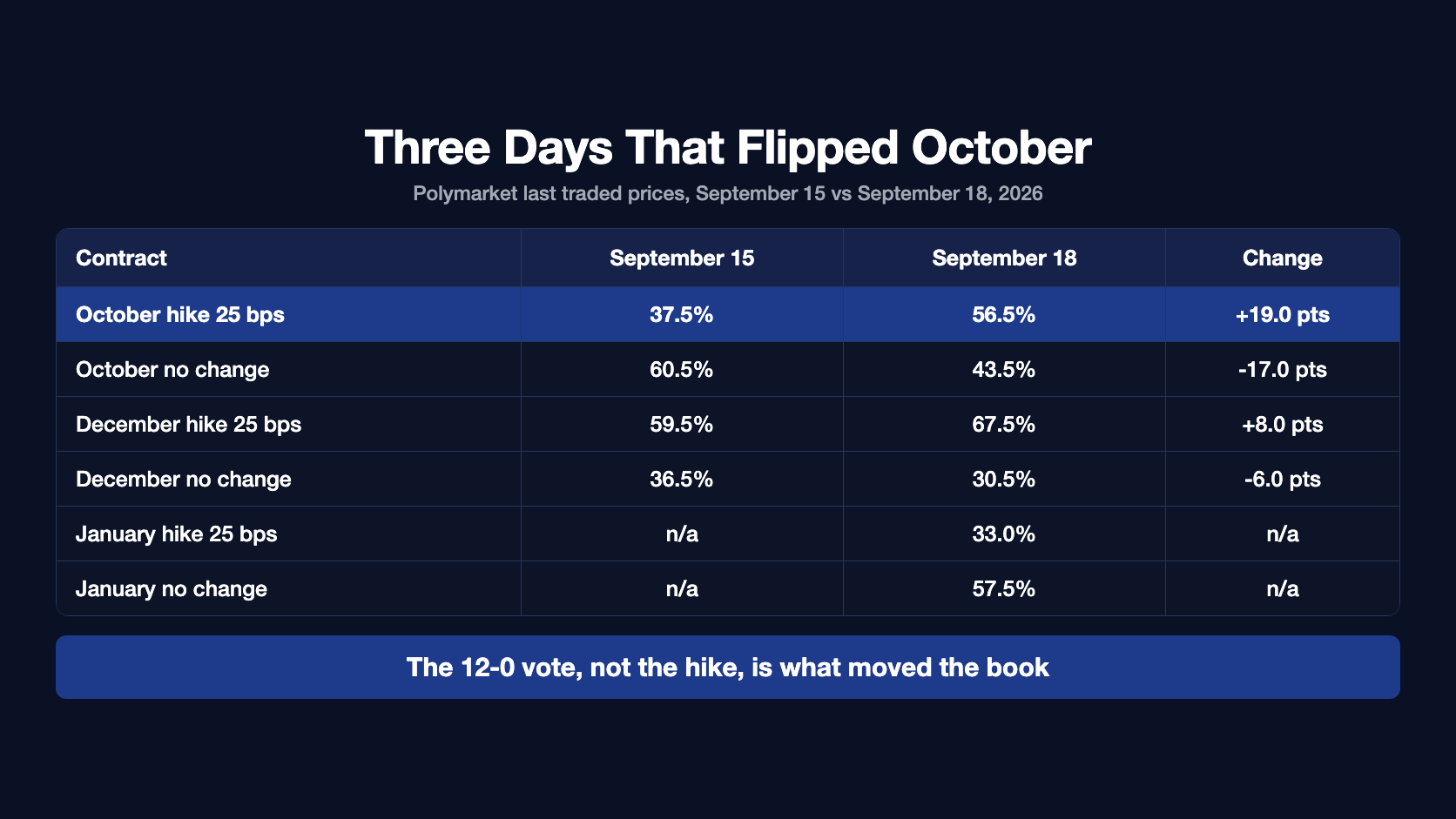
| Contract | September 15 | September 18 | Change |
|---|---|---|---|
| October hike 25 bps | 37.5% | 56.5% | +19.0 pts |
| October no change | 60.5% | 43.5% | -17.0 pts |
| December hike 25 bps | 59.5% | 67.5% | +8.0 pts |
| December no change | 36.5% | 30.5% | -6.0 pts |
| January hike 25 bps | n/a | 33.0% | n/a |
| January no change | n/a | 57.5% | n/a |
Polymarket last traded prices. The September 15 column was captured at 21:20 UTC for our December preview; the September 18 column at 16:20 UTC. The January 2027 event was too thin to quote on September 15.
A unanimous vote is the part the market got wrong. Polymarket's dissent book had a unanimous September at 35.5% the evening before, with two or more dissents at 41.7%. The July meeting had held rates 9 to 3, with three members dissenting in favour of a hike, so a room that split three ways in July closing ranks completely in September was the genuine news of the day.
Unanimity reads as a signal about the next meeting rather than this one. A 12-0 vote says the doves accepted the hawks' framing, and a committee that has stopped arguing is a committee that can move again without a fight. October did not become more likely because the Fed hiked. It became more likely because nobody voted against it.
Kevin Warsh reinforced that in the press conference, saying inflation has been "too high for too long" and describing broad financial conditions as accommodative rather than restrictive. Asked about the new projections, he said plainly that "those aren't my forecasts", which markets read as a chair who wants to move faster than his own committee's median.
Three Venues, One Number: Polymarket, Kalshi and CME FedWatch
I check this every time, because a persistent gap between the books is usually the best evidence that one of them is stale. On October there is nothing to choose between any of the three.
| Source | Instrument | October hike probability | Spread to Polymarket |
|---|---|---|---|
| Polymarket | Binary outcome contracts, normalised | 56.4% | - |
| Kalshi | Bid/ask midpoint, KXFEDDECISION-26OCT-H25 | 55.5% | 0.9 pts |
| CME FedWatch | Fed funds futures, September 17 | 55.1% | 1.3 pts |
| Range across all three | 55.1% to 56.4% | 1.3 pts |
CME FedWatch reading as reported on September 17, 2026. The other two captured September 18, 2026, 16:20 UTC. FedWatch is derived from fed funds futures rather than an explicit probability market, so exact agreement is not expected.
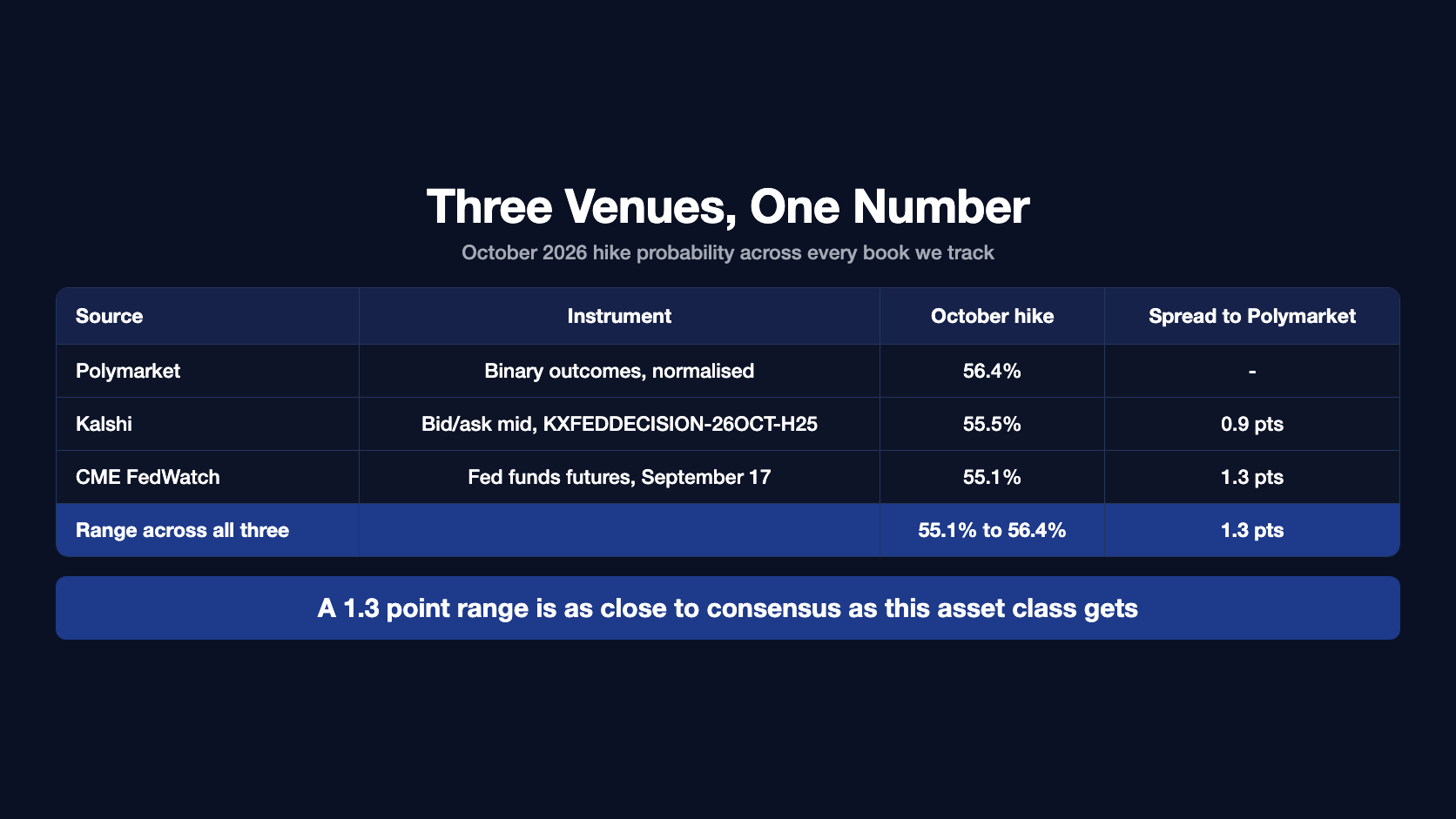
A 1.3 point range across three venues with different users, different collateral, different regulators and two entirely different instruments is about as close to consensus as this asset class produces. When Polymarket and Kalshi agree but FedWatch does not, the usual explanation is that the futures curve is being distorted by month end positioning. That is not happening here.
The practical upshot for anyone reading headline numbers off different sites: you will see 55%, 56% and 57% quoted for the same meeting this week, and they are the same number. We keep the two prediction market books side by side on the Fed decision odds page so the comparison is always current rather than a snapshot.
What the September Dot Plot Actually Said
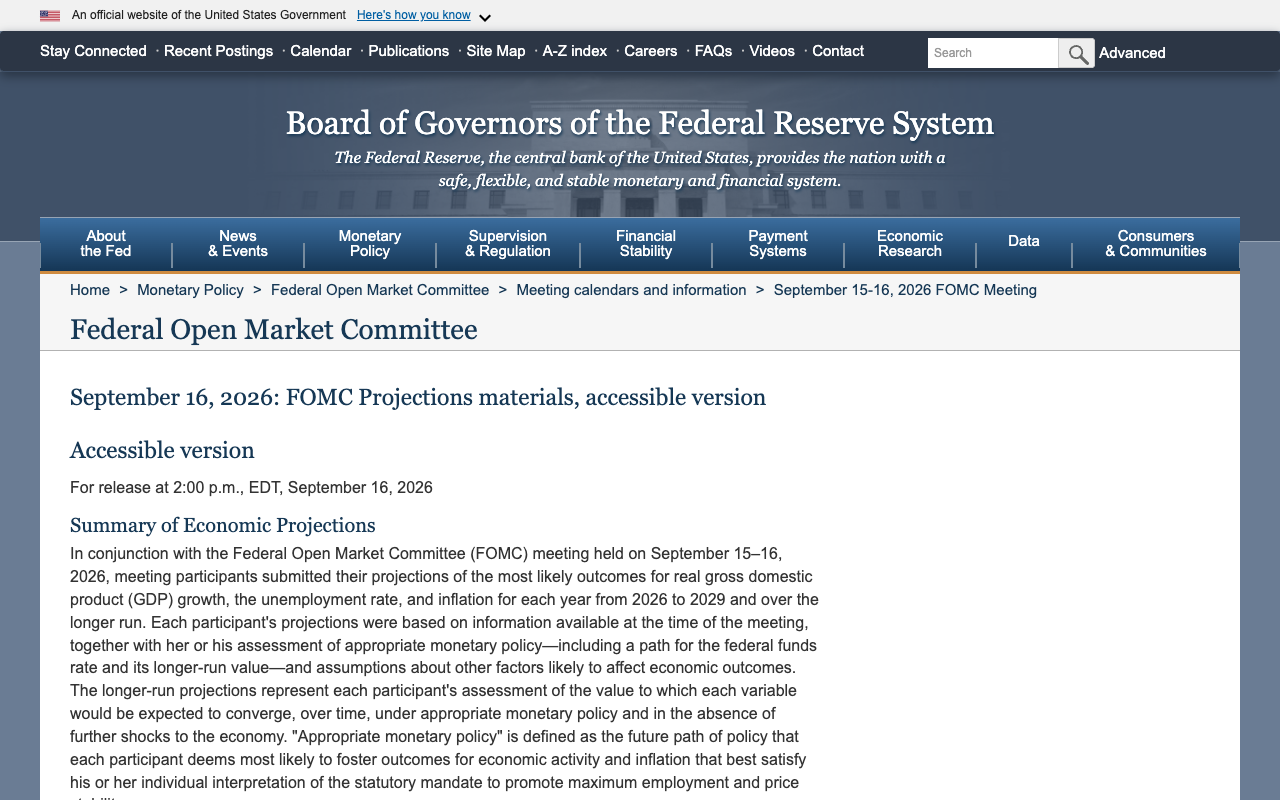
The September meeting was a projections meeting, so it came with a new Summary of Economic Projections. This is the first full look at where the committee stands since June, and the revisions are larger than the usual quarterly drift.
| Median projection | June 2026 | September 2026 | Revision |
|---|---|---|---|
| Fed funds rate, end 2026 | 3.8% | 4.1% | +0.3 pts |
| Fed funds rate, end 2027 | 3.6% | 4.1% | +0.5 pts |
| Fed funds rate, end 2028 | 3.4% | 3.9% | +0.5 pts |
| Fed funds rate, longer run | 3.1% | 3.2% | +0.1 pts |
| Unemployment rate, 2026 | 4.3% | 4.1% | -0.2 pts |
| Real GDP growth, 2026 | 2.2% | 2.3% | +0.1 pts |
| PCE inflation, 2026 | 3.6% | 3.7% | +0.1 pts |
| Core PCE inflation, 2026 | 3.3% | 3.4% | +0.1 pts |
Federal Reserve Summary of Economic Projections, September 16, 2026, against the June 17, 2026 edition. Medians of participants' individual projections.
Read the top half first. The end-2026 median moved from 3.8% to 4.1%, and the current midpoint after the September hike is 3.875%. A median of 4.1% is the committee saying, collectively, that it expects one more hike this year and has not decided which meeting it belongs to. Sixteen of the eighteen participants who submitted a dot expect at least one more increase, and four of them expect two.
The 2027 line is the one that should worry anyone hoping this ends quickly. In June the committee penciled a cut back to 3.6% during 2027. It has now erased that entirely and put 2027 at 4.1%, level with 2026. Eight participants project a further hike next year and only four project any cut at all, which is a different world from the one the when will the Fed cut rates question assumed for most of this cycle.
One structural oddity worth flagging, because it changes how you should read the median: Warsh has chosen not to submit a dot since taking the chair. The distribution above is therefore the committee without its chair, and the chair has been the most hawkish voice in the building all year.
The Market and the Fed Have Nearly Converged
Before the September meeting the market was pricing meaningfully more tightening than the Fed's own projections implied, and I flagged that 28 basis point gap as the thing most likely to resolve badly for somebody. It has largely closed, and it closed by the Fed moving toward the market rather than the other way round.
| After | Expected move | Implied midpoint | Implied range |
|---|---|---|---|
| Today | 3.875% | 3.75-4.00% | |
| October 28 | +14.0 bps | 4.015% | 4.00-4.25% |
| December 9 | +16.5 bps | 4.180% | 4.00-4.25% |
| Fed's September median | 4.100% | 4.00-4.25% | |
| Gap, market less Fed | +8.0 bps |
Market implied path from Polymarket outcome prices normalised per meeting, September 18, 2026. Expected move treats the "more than 25 bps" buckets as 50 bps. The Fed median is from the September 16, 2026 SEP.
So the market ends 2026 at 4.18% and the Fed's own new median ends it at 4.10%. An 8 basis point gap is noise. For the first time this year, the prediction markets and the committee's published projections are telling the same story, and both of them land inside a 4.00% to 4.25% target range.
The usual caveat applies and it is not a small one. These are separate binary books, not a joint distribution, so you cannot multiply October by December to get a clean probability of exactly two hikes. The same news that lifts one lifts the other. The expected move is the honest summary statistic, and at +30.5 basis points across two meetings it comes to about 1.2 quarter point hikes.
Why October Is a Harder Call Than December
December still prices higher than October, at 67.6% against 56.4% normalised, and the reasons are structural rather than economic. Put the two meetings side by side and the asymmetry is obvious.
| October 27-28 | December 8-9 | |
|---|---|---|
| Publishes projections (SEP) | No | Yes |
| Jobs reports before it | 1 (Oct 2) | 3 (Oct 2, Nov 6, Dec 4) |
| CPI prints before it | 1 (Oct 14) | 2 (Oct 14, Nov 10) |
| Core PCE prints before it | 0 | 2 (Oct 29, Nov 25) |
| Polymarket hike probability | 56.4% | 67.6% |
| Polymarket event volume | $7.3m | $1.1m |
Release dates from the BLS, BEA and Census schedules tracked on our macro calendar. Probabilities normalised from Polymarket outcome prices, September 18, 2026.
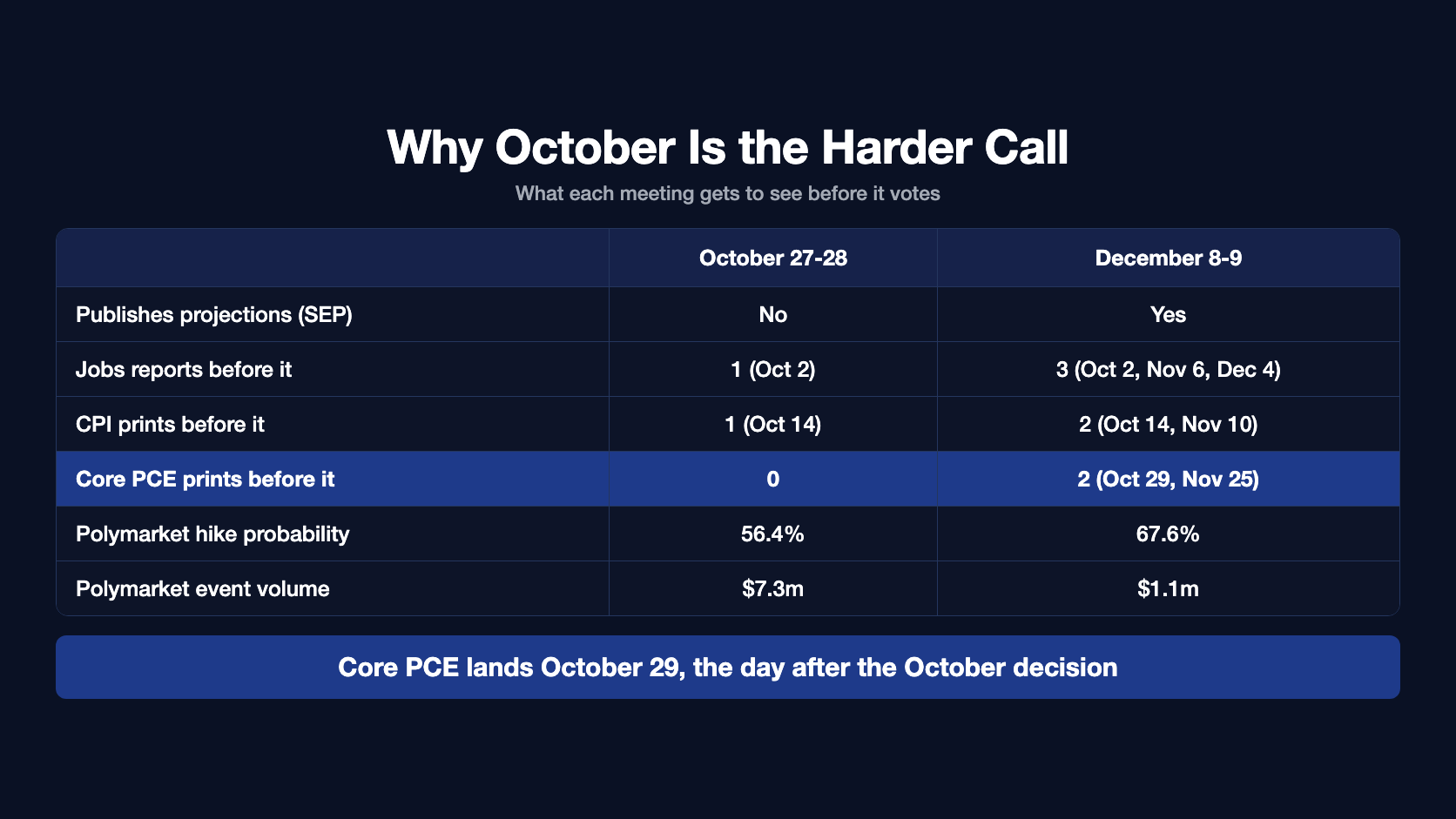
The core PCE row is the one almost nobody mentions, and I think it is the strongest single argument for October being the lower probability of the two. Core PCE is the Fed's preferred inflation gauge, and the September reading lands on October 29, the day after the October decision. The committee would be moving in October with its own favourite number sitting unopened on the desk.
The projections point compounds it. October publishes no SEP, so the committee cannot show its reasoning alongside the move, and the 2026 FOMC calendar gives it that chance seven weeks later. That argument was worth more when the committee was split three ways. After a 12-0 vote it is worth considerably less, which is exactly why October repriced 19 points and December only 8.
My own read, for what it is worth: I think 56.4% for October is now marginally too high and 67.6% for December is about right. One CPI print and one jobs report is thin evidence on which to deliver back to back hikes for the first time since 2023, and the Fed gets to see four more major releases plus a fresh dot plot if it simply waits.
The Dissent Market After a Unanimous Vote
There is a market almost nobody looks at that I think is more informative than the rate contracts: the number of dissenting votes. It called September badly, which makes what it says about October more interesting, not less.
| Dissenting votes | September (priced Sep 15) | September (actual) | October (priced now) |
|---|---|---|---|
| 0 | 35.5% | Correct outcome | 43.6% |
| 1 | 24.0% | 19.0% | |
| 2 | 24.0% | 8.5% | |
| 3 | 12.0% | 11.4% | |
| 4 or more | 6.5% | 17.5% | |
| Two or more | 41.7% | 37.4% |
Polymarket "How many dissent at the September / October Fed meeting?" events, normalised. September column captured September 15, 2026, 21:20 UTC; October column September 18, 2026, 16:20 UTC. The October book is thin at roughly $4,200 of volume, so read it as a sketch rather than a measurement.
Traders have raised the odds of another unanimous vote from 35.5% to 43.6%, which is the sensible update after being wrong in the same direction three days ago. What is strange is the bottom of the table. Four or more dissents has nearly tripled from 6.5% to 17.5%, at the same time as unanimity became more likely.
That is a barbell, and on a $4,200 book I would not over-read it. But the shape is at least coherent: if the Fed holds in October the hawks who have wanted to move all year have something to dissent about, and if it hikes the doves do. The middle outcomes, one or two dissents, are the ones that have been squeezed out.
If you want to check how well these markets have actually called things rather than taking my framing on trust, our accuracy scorecard tracks every resolved Fed contract against the outcome, including the September dissent miss.
What Moves October Odds Before the Meeting
Between now and October 28 there are six scheduled releases that matter and one thing with no release date. Here is the calendar the October contract will actually trade on.
| Date | Release | Period | Why it moves the October contract |
|---|---|---|---|
| Oct 1 | ISM Manufacturing PMI | September | First read on the quarter, low weight |
| Oct 2 | Employment Situation | September | The only jobs report before the meeting |
| Oct 5 | ISM Services PMI | September | Services inflation proxy |
| Oct 6 | JOLTS | August | Labour tightness, lagging |
| Oct 14 | Consumer Price Index | September | The decisive print, watch core |
| Oct 15 | PPI and retail sales | September | Pipeline pressure and demand |
| Oct 29 | Core PCE and Q3 GDP | September / Q3 | Lands the day AFTER the decision |
Scheduled release dates from the BLS, BEA, Census and ISM calendars. All times 08:30 Eastern except the PMIs and JOLTS at 10:00.
- September CPI on October 14 decides this. Core CPI printed 2.4% in August, its lowest since March 2021, while headline held at 3.4% on an energy shock. Two tenths in either direction on core moves the October contract more than everything else on that calendar combined.
- The September jobs report on October 2. Payrolls came in at 162,000 in August against a consensus near 53,000. A repeat gives the hawks a growth argument to pair with the credibility argument; a print back in the thirties hands the doves their case back.
- The oil price. Headline inflation is elevated because crude crossed $100 after the February supply disruption. If crude falls back under $90, headline converges down toward core and the argument for hiking against a supply shock weakens.
- Warsh's public remarks. He has moved these markets more than any single data point this year, and his Jackson Hole remarks on August 28 roughly doubled September hike odds inside a week. There is no calendar for this.
- Anything from the Treasury or the White House. Political pressure on the Fed has been a live variable all year, and Warsh spent a chunk of his press conference asserting the institution's independence, which is not something a chair does unprompted.
One asymmetry to keep in mind while watching those. The October contract can fall a long way on a soft CPI print and has comparatively little room to rise, because 56.4% already assumes the hike. A hot core reading takes it to perhaps 75%; a soft one takes it to 30%. The downside is the bigger move, and that is usually a sign the market is slightly over its skis.
Frequently asked questions
What are the odds of a Fed rate hike in October 2026?
As of September 18, 2026, Polymarket prices a 25 basis point hike at the October 27-28 meeting at 56.5%, and Kalshi's equivalent contract sits at a 55.5% midpoint. Normalised across every outcome, that is a 56.4% chance of any hike, 42.7% for no change and 1.0% for a cut. CME FedWatch put the same meeting at 55.1% on September 17.
Why did October rate hike odds jump so much?
The September 16 decision was a unanimous 12-0 vote, and almost nobody had priced that. Polymarket's dissent market gave a unanimous September only a 35.5% chance the evening before. A committee that split 9 to 3 in July and then closed ranks completely signals that it can move again without a fight, so October repriced from 37.5% to 56.5% in three days.
What did the Fed do at the September 2026 meeting?
The FOMC raised the target range by 25 basis points to 3.75% to 4.00% on September 16, 2026, its first increase since July 2023. The vote was unanimous. Chair Kevin Warsh said inflation had been "too high for too long" and described broad financial conditions as accommodative rather than restrictive.
When is the October 2026 FOMC meeting?
The Federal Open Market Committee meets October 27-28, 2026, with the decision published at 2:00 pm Eastern on October 28 and the chair's press conference at 2:30 pm. It is not a projections meeting, so there is no Summary of Economic Projections and no new dot plot until December.
How high will the fed funds rate be at the end of 2026?
Chaining the expected move from the two remaining meetings gives a market implied midpoint of 4.18%, which sits inside a 4.00% to 4.25% target range. That is 30.5 basis points above the current 3.875% midpoint, or about 1.2 quarter point hikes. The Fed's own September median projection is 4.1%, so the two are only 8 basis points apart.
Does the September dot plot show more hikes in 2027?
It no longer shows cuts. The June 2026 projections had the fed funds rate falling to 3.6% during 2027; the September edition puts 2027 at 4.1%, level with 2026. Eight participants project a further increase next year and only four project any cut, so the committee has erased the easing it penciled in three months earlier.
Is Polymarket or Kalshi more accurate on Fed decisions?
On current pricing there is nothing to choose between them, and CME FedWatch agrees too. The three sit in a 1.3 point range on October. Kalshi is a CFTC regulated exchange available to US residents, while Polymarket carries more volume on the near dated Fed contracts, roughly $7.3 million on the October event against Kalshi's 261,277 contracts of open interest on the hike leg.
Why might the Fed skip October and hike in December instead?
December publishes a Summary of Economic Projections and October does not, so a committee can show its reasoning alongside a December move. December also gets far more evidence first: three jobs reports and two CPI prints against October's one of each. Most tellingly, September core PCE, the Fed's preferred inflation gauge, is released on October 29, the day after the October decision.